7-inch long-range cruiser: 14 minutes on a 21700 pack
A 7-inch cruiser is not a scaled-up 5-inch. The arms are longer, the props are bigger and the whole aircraft is built around one number: how much current it draws at 55 percent throttle. This build returns 14.5 minutes of mixed cruise from a 6S 3000 mAh lithium-ion pack at 1042 g all-up.
Published 2026-08-29 · 295 mm · 1042 g · 14.5 min
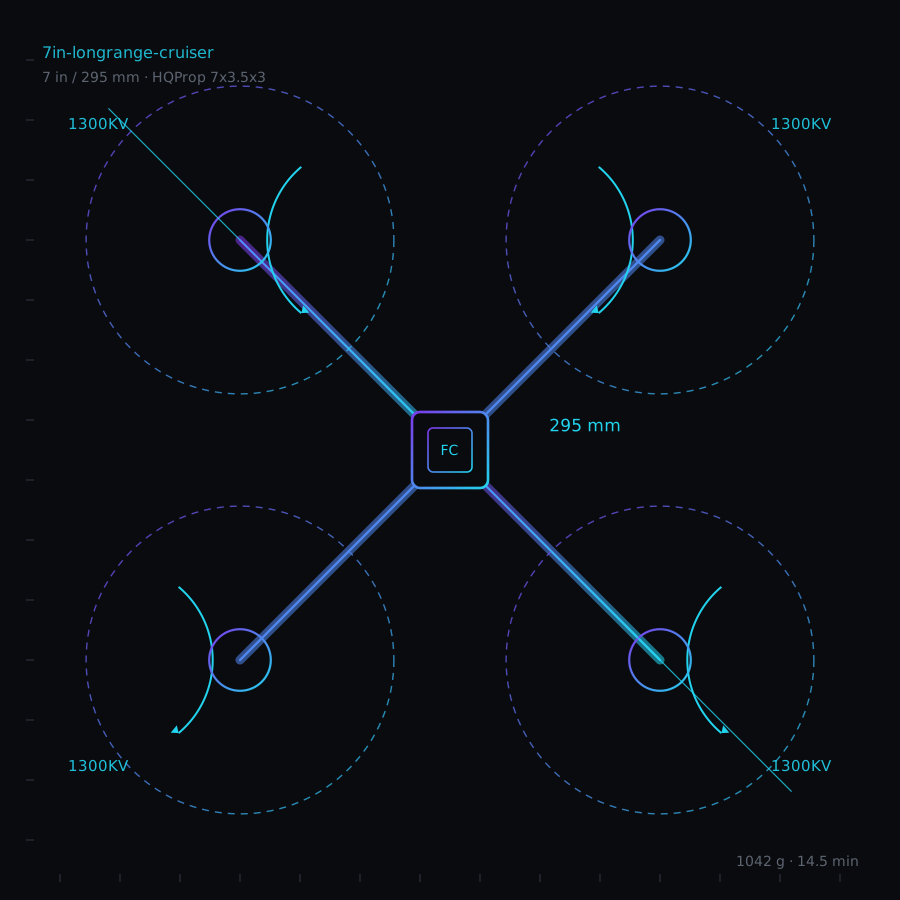
| Wheelbase | 7 in / 295 mm (295 mm) |
|---|---|
| Motors | 1300 KV |
| Props | HQProp 7x3.5x3 |
| ESC | BLHeli_32 · DShot300 |
| VTX | 1000 mW · 5.8 GHz |
| Link | ExpressLRS 915 MHz · 100 Hz |
| AUW | 1042 g |
| Flight | 14.5 min |
| Thrust to weight | 4.03 : 1 |
| Rate limit | Actual 480 deg/s · expo 0.72 |
| Filters | PT1 90 Hz / PT1 85 Hz |
| Dynamic notch | Biquad 70-220 Hz |
| RPM filter | On (bidirectional DShot) |
Rates
- Max rate — Actual 480 deg/s · expo 0.72
- Expo — 0.72 · centre sensitivity 180
- Throttle mid — 0.42 · expo 0.18
- Filters — PT1 90 Hz / PT1 85 Hz / Biquad 70-220 Hz
Tuning pass
- Fit the arm brace first, then re-check the frame resonance by flicking a motor and watching the blackbox spectrum.
- Set the gyro lowpass to 90 Hz and the dynamic notch range to 70-220 Hz before touching PID.
- Enter the PID values above, then raise roll I until a slow forward drift in a hover stops oscillating.
- Set the throttle curve with mid at 0.42 and expo at 0.18 so that cruise sits at a comfortable stick position.
- Configure GPS rescue with an 8 satellite minimum, a 60 m rescue altitude and a 12 second hover delay.
- Set the battery warning to 3.5 V per cell and the landing warning to 3.35 V per cell.
- Test rescue deliberately at 300 m range and log the current draw during the climb.
Assembly order
- Mount the GPS on a mast at least 40 mm above the battery so the patch has a clear sky view.
- Twist the GPS and receiver wiring and keep it away from the VTX power leads.
- Install the VTX on a heatsink with the fins facing the prop wash and confirm airflow with a bench run.
- Balance the props with a magnetic balancer; a 7-inch prop that is 0.05 g out will show up as a 40 Hz wobble.
- Calibrate the current sensor against a watt meter at 10 A and again at 25 A.
- Set the battery capacity to 3000 mAh and the consumed-capacity warning to 2400 mAh.
- Fly a 1 km out-and-back first, then extend the range in 1 km steps while logging the pack voltage under load.
Arm length and stiffness come before power
At 295 mm motor-to-motor the first bending mode of a 6 mm arm sits around 95 Hz, which is close enough to the prop passing frequency at cruise that you will feel it as a slow wobble rather than a buzz. Adding a 3 mm carbon brace across the arm pair moves the mode up to about 140 Hz and costs 11 g. On this frame that brace was worth more than any PID change.
Matching motor and prop for efficiency
2806.5 at 1300 KV on 6S turns a 7x3.5x3 at about 9800 RPM at 55 percent throttle, drawing 9.5 A total. A 1500 KV motor on the same prop draws 13 A for roughly 20 percent more thrust you will never use in a cruise. The efficiency window for this class is 8 to 12 A total; anything above 18 A is a different aircraft.
GPS rescue settings that actually trigger
Rescue is only useful if it arms before the link drops. Set the minimum satellite count to 8 and the rescue altitude to 60 m, then test it deliberately: fly 300 m out, switch the transmitter off and confirm the quad climbs, turns and comes home. On this build rescue draws 22 A during the climb, so the pack needs at least 35 percent charge for a safe return from 4 km.
VTX power versus heat
1000 mW on 5.8 GHz is enough for 6 km with a good antenna set, but a bare VTX will hit 90 degrees C in still air. Mounting it on a 40 mm heatsink with the fins in the prop wash keeps it near 62 degrees C. Powering down to 500 mW below 2 km cuts the heat further and costs nothing in range.
Battery discipline on lithium-ion
A 6S 3000 mAh 21700 pack sags less than a LiPo, which makes it tempting to fly to 3.0 V per cell. Do not: the useful floor for cell life is 3.3 V per cell under a 10 A load, which on this rig is about 12 minutes of cruise. Set the voltage warning at 3.5 V and land at 3.35 V.
What this rig is not for
It will not freestyle. The 480 deg/s rate limit and the 1042 g weight mean a fast flip loses about 9 m of altitude. Keep the cruiser in long, flat lines, and if you want to fly proximity, take the 5-inch.
Build parts
- Frame - 295 mm deadcat, 6 mm arms, aluminium camera cage
- Motors - 4 x 2806.5 1300 KV, 12N14P
- ESC - 4-in-1 60 A, BLHeli_32 32.9
- Flight controller - H7, 30x30 mm, dual gyro
- Props - HQProp 7x3.5x3
- VTX - 5.8 GHz 1000 mW with a 40 mm heatsink
- Receiver - ExpressLRS 915 MHz, 100 Hz packet rate
- GPS - M10 module with a 25 mm ceramic patch, mounted on a mast
- Battery - 6S 3000 mAh Li-Ion 21700 pack
- Camera - 19 mm analogue plus a 4K action camera on a soft mount
Common mistakes
- Flying to 3.0 V per cell on lithium-ion and losing 30 percent of the pack capacity within twenty cycles.
- Leaving the rescue altitude at the default 100 m, which on a 4 km return wastes 30 percent of the pack.
- Mounting the GPS next to the VTX and waiting for a lock that never gets past 5 satellites.
What matters
- 295 mm arms with a brace fly better than 295 mm arms without one; the brace costs 11 g.
- 2806.5 at 1300 KV draws 9.5 A at cruise; efficiency lives between 8 and 12 A.
- Test GPS rescue on purpose at 300 m before you trust it at 4 km.
- A 6S 3000 mAh 21700 pack returns about 14.5 minutes of mixed cruise at 1042 g.