75 mm 2S whoop: the garden quad that handles wind
A 65 mm 1S whoop is a living room toy. A 75 mm on 2S is a real aircraft: 47 g, 3.4 minutes, and enough thrust to fly a garden line in 12 km/h of wind without being pushed into the hedge.
Published By The Rotor Desk 75 mm · 47 g · 3.4 min
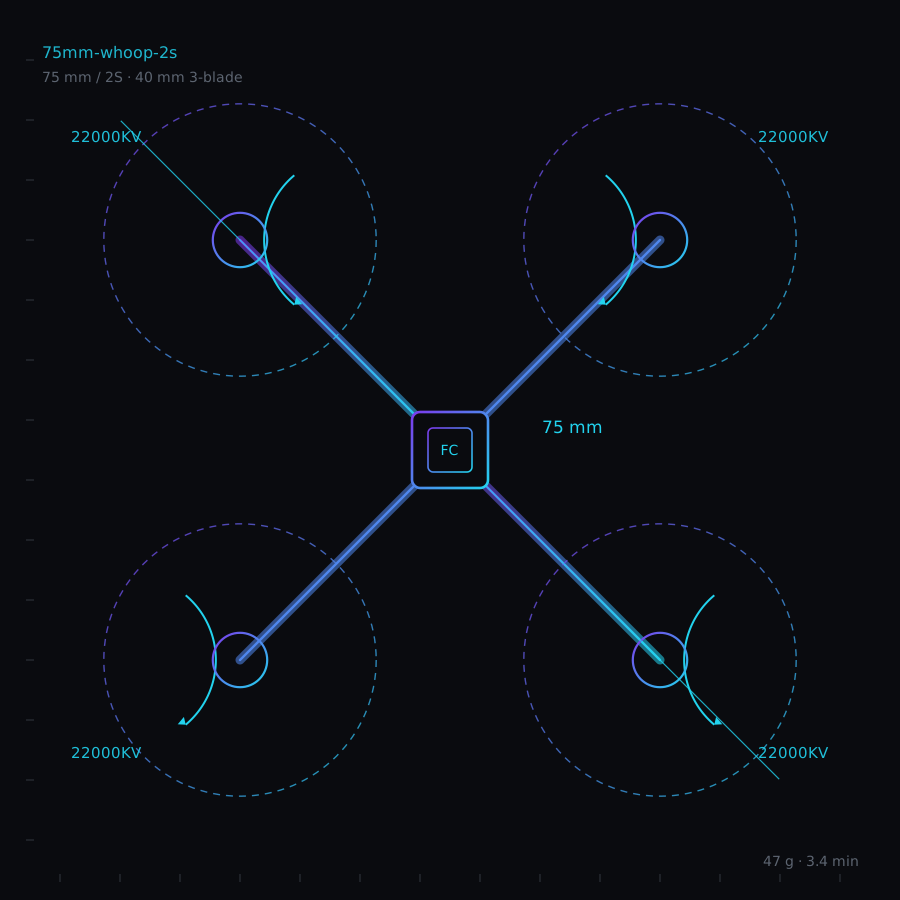
| Wheelbase | 75 mm / 2S (75 mm) |
|---|---|
| Motors | 22000 KV |
| Props | 40 mm 3-blade |
| ESC | Bluejay · DShot300 |
| VTX | 200 mW · 5.8 GHz |
| Link | ExpressLRS 2.4 GHz · 150 Hz |
| AUW | 47 g |
| Flight | 3.4 min |
| Thrust to weight | 3.15 : 1 |
| Rate limit | Actual 650 deg/s · expo 0.42 |
| Filters | PT1 190 Hz / PT1 180 Hz |
| Dynamic notch | Off |
| RPM filter | On (bidirectional DShot) |
Rates
- Max rate — Actual 650 deg/s · expo 0.42
- Expo — 0.42 · centre sensitivity 250
- Throttle mid — 0.48 · expo 0.08
- Filters — PT1 190 Hz / PT1 180 Hz / Off
Tuning pass
- Flash Bluejay at 48 kHz with DShot300 and confirm the AIO handles 2S without an external BEC.
- Enter roll P 72 / I 132 / D 32 and pitch P 76 / I 138 / D 34, then hover for 20 seconds.
- Leave the dynamic notch off and enable the RPM filter with the eRPM ratio set for 12N14P.
- Set 650 deg/s with 0.42 expo, a throttle mid of 0.48 and 0.08 throttle expo.
- Set failsafe to Stage 2 with a 0.2 second delay and a hard drop.
- Check the prop-to-duct clearance with a paper strip on all four corners.
- Fly three packs and time them; when the time drops below 2.7 minutes, replace the battery pigtail.
Assembly order
- Fit the carbon brace across the frame before mounting the AIO board.
- Check the prop-to-duct gap and adjust the ducts until the paper strip passes on all four corners.
- Solder an XT30 pigtail with 18 AWG wire; a thin pigtail will cost you 0.2 V under load.
- Mount the AIO with grommets and confirm no solder joint touches the frame.
- Bind the receiver, set the failsafe and confirm the model matches the transmitter before props go on.
- Set the battery profile to 2S 450 mAh and the voltage warning to 3.4 V per cell.
- Hover for 30 seconds and land to feel the motors; a warm 0802 means a prop strike or a bad bearing.
What 2S buys you over 1S
Going from 1S to 2S at the same 0802 22000 KV roughly doubles the available thrust and takes the aircraft from 29 g to 47 g, but the current also goes from 4.1 A to 9.6 A. The practical result is 3.4 minutes instead of 2.6 and the ability to recover from a fast descent in about half the distance.
Prop diameter and the duct gap
75 mm frames run 40 mm props with a 1.0 mm hub, which leaves about 1.5 mm of clearance to the duct. That gap is the single most important dimension on the aircraft: at 0.5 mm the props touch the duct in a hard turn and the quad yaws unpredictably, and at 3 mm the ducts stop doing useful work. If you replace a frame, check the gap with a strip of paper before flying.
Tuning a 2S whoop
Roll P 72 and pitch P 76 with D at 32 and 34 is a mid-range starting point; the ducts damp the frame, so raising D produces a shimmer instead of removing one. I at 132 and 138 is what holds the aircraft steady when you cross your own wake in a tight garden turn. Leave the dynamic notch off: the RPM filter handles the motor noise and the notch only adds latency at these RPMs.
Rates and the wind problem
650 deg/s with 0.42 expo and a throttle mid of 0.48. The throttle curve matters more than the rates in wind: at 0.48 mid, half stick is roughly the hover point, so a gust can be corrected with a small stick movement rather than a large one. In 12 km/h of wind this build drifts about 1.2 m over a 4 second hover.
Battery and connector discipline
A 2S 450 mAh pack with an XT30 adds 32 g and gives 3.4 minutes. The connector is not optional: a PH2.0 connector at 9.6 A drops about 0.25 V and its contacts wear out after roughly 60 mating cycles, which shows up as a sudden 20 percent loss of flight time. Replace the pigtail when the flight time drops.
Build parts
- Frame - 75 mm whoop frame with a 1.5 mm carbon brace
- Motors - 4 x 0802 22000 KV
- ESC - all-in-one 12 A board, 2S capable
- Flight controller - 2S AIO with an on-board receiver option
- Props - 40 mm 3-blade, 1.0 mm hub
- VTX - 5.8 GHz 200 mW, raceband
- Receiver - ExpressLRS 2.4 GHz, 150 Hz
- Battery - 2S 450 mAh 75C LiPo with an XT30
- Camera - integrated 1/3 in analogue, 2.1 mm lens
Common mistakes
- Running a PH2.0 connector at 9.6 A and losing 0.25 V plus flight time.
- Replacing a duct without checking the prop clearance, which turns a stable quad into one that yaws randomly.
- Copying a 1S tune onto a 2S build; the I term will be about 20 percent too low.
What matters
- 2S at 0802 22000 KV roughly doubles thrust over 1S and gives 3.4 minutes at 47 g.
- Keep 1.5 mm of prop-to-duct clearance; 0.5 mm makes the aircraft yaw unpredictably.
- Leave the dynamic notch off and let the RPM filter handle motor noise.
- Use an XT30 at 9.6 A; a PH2.0 costs 0.25 V and wears out in about 60 cycles.