5-inch digital HD freestyle: tuning around 30 ms of latency
A digital video link changes how the aircraft feels before it changes how it looks. At 742 g with an air unit on board, the extra 60 g and the roughly 30 ms of link latency mean the tune has to be smoother and the rates slightly lower than the analogue build it replaced, or you will fly into things you already corrected for.
Published By The Rotor Desk 220 mm · 742 g · 4 min
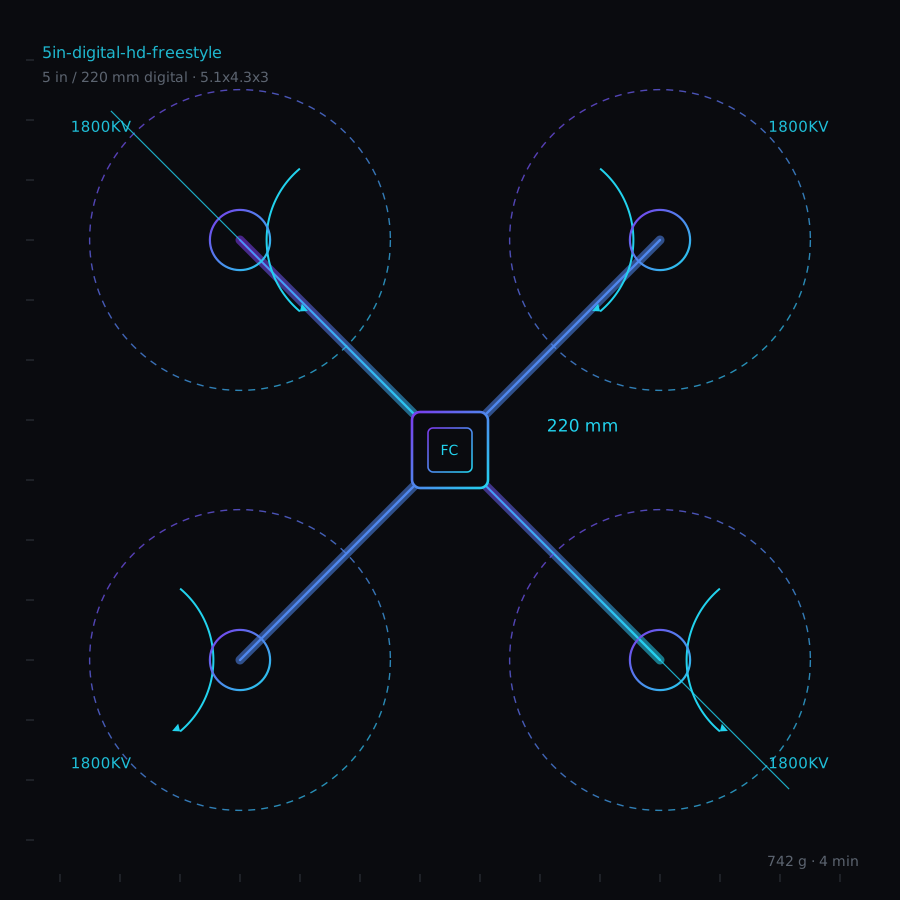
| Wheelbase | 5 in / 220 mm digital (220 mm) |
|---|---|
| Motors | 1800 KV |
| Props | 5.1x4.3x3 |
| ESC | AM32 · DShot600 |
| VTX | 1000 mW digital air unit |
| Link | ExpressLRS 2.4 GHz · 250 Hz |
| AUW | 742 g |
| Flight | 4 min |
| Thrust to weight | 3.91 : 1 |
| Rate limit | Actual 800 deg/s · expo 0.55 |
| Filters | PT1 115 Hz / PT1 105 Hz |
| Dynamic notch | Biquad 95-290 Hz |
| RPM filter | On (bidirectional DShot) |
Rates
- Max rate — Actual 800 deg/s · expo 0.55
- Expo — 0.55 · centre sensitivity 215
- Throttle mid — 0.5 · expo 0.04
- Filters — PT1 115 Hz / PT1 105 Hz / Biquad 95-290 Hz
Tuning pass
- Set the ESC to DShot600 with AM32 and enable bidirectional telemetry for the RPM filter.
- Enter roll P 50 / I 88 / D 40 and pitch P 53 / I 92 / D 43, then fly a line of fast direction changes.
- Set the gyro lowpass to 115 Hz and the dynamic notch to 95-290 Hz.
- Set 800 deg/s with 0.55 expo, a centre sensitivity of 215 and 0.04 throttle expo.
- Log a flight with the air unit statistics enabled and check for a correlation between packet loss and wobble.
- Set failsafe to Stage 2 with a 0.35 second delay and no rescue.
- Measure the air unit heatsink temperature after a two-minute flight and confirm it stays below 80 degrees C.
Assembly order
- Mount the air unit with the heatsink fins in the prop wash and at least 8 mm of clearance from the flight controller.
- Fit the digital camera and set the tilt to 30 degrees; check the props are out of frame at that angle.
- Balance the props on a magnetic balancer; the digital link shows vibration as a softness in the image rather than as jitter.
- Enable the blackbox and confirm the flash chip is detected before the first flight.
- Set the battery profile to 6S 1300 mAh and the landing warning to 3.5 V per cell.
- Calibrate the current sensor at 15 A and 35 A against a watt meter.
- Fly two minutes, land and measure the air unit heatsink temperature with an infrared thermometer.
What 30 ms of latency does to a tune
You see the aircraft's attitude about 30 ms after it happened, which at 800 deg/s is 24 degrees of rotation. The correction you make is therefore always slightly late, and a sharp tune turns that into an overshoot. Roll P 50 with D 40 and pitch P 53 with D 43 is a softer profile than the analogue equivalent, and the point of it is to reduce the size of the late correction rather than to remove the latency.
1800 KV on 6S and the extra weight
2207 at 1800 KV on 6S turns a 5.1x4.3x3 at about 23000 RPM at full throttle and draws 38 A for the aircraft; at a freestyle cruise of 55 percent throttle the current is 11.2 A, giving 4.0 minutes from a 1300 mAh pack. The air unit draws 0.9 A of that and adds 60 g, which between them costs about 50 seconds of flight time against the analogue build.
Blackbox is the real reason to tune digitally
The air unit records its own link statistics, so in a blackbox overlay you can correlate a control wobble with a link quality drop. On this build a 4 percent packet loss at 1 km produced a visible 3 Hz wobble that had nothing to do with the PID. Without the log, the obvious but wrong fix is to lower the D term, which makes the aircraft fly worse everywhere else.
Rates for a heavier, laggier aircraft
800 deg/s with 0.55 expo and a centre sensitivity of 215. The maximum rate is 50 deg/s lower than the analogue build because the aircraft must be able to stop the rotation within the latency window; if it cannot, every fast input becomes a two-part correction. Throttle expo stays low at 0.04 because the air unit's latency makes the feel of the low end harder to judge, and a soft low end compounds that.
Thermal management with a 1000 mW air unit
A 1000 mW digital air unit reaches about 95 degrees C in still air and needs airflow across its heatsink. Mounting it so the fins sit in the prop wash keeps it near 68 degrees C. Above 80 degrees C the unit will drop its power and the image gets noticeably softer, which is easy to mistake for a camera problem rather than a thermal one.
Build parts
- Frame - 220 mm, 5 mm arms, digital air unit mount
- Motors - 4 x 2207 1800 KV
- ESC - 4-in-1 55 A, AM32 2.17
- Flight controller - F7 30x30 mm with 8 MB blackbox flash
- Props - 5.1x4.3x3
- VTX - digital air unit, 1000 mW, 1080p100
- Receiver - ExpressLRS 2.4 GHz, 250 Hz
- Battery - 6S 1300 mAh 120C LiPo
- Camera - digital camera module, 1/1.8 in sensor
Common mistakes
- Lowering the D term to fix a wobble that the link statistics show is caused by packet loss.
- Running a 1000 mW air unit with no airflow over the heatsink and losing image quality to thermal throttling.
- Setting a higher rate profile than the latency allows and flying into obstacles you had already corrected for.
What matters
- At 800 deg/s a 30 ms link latency is 24 degrees of rotation, which is why the tune has to be softer.
- The air unit costs 0.9 A and 60 g, about 50 seconds of flight time against an analogue build.
- Use the air unit link statistics before touching the D term to fix a wobble.
- Keep the air unit heatsink below 80 degrees C; above that the image softens as the unit throttles.