6-inch long range: the middle size nobody builds
Six-inch sits between the agility of a 5-inch and the efficiency of a 7-inch, and for most people it is the better compromise: it carries an action camera at 826 g and still returns 12.4 minutes on a 6S 2200 mAh pack, while a 7-inch needs a bigger pack to show the same advantage.
Published 2026-09-20 · 255 mm · 826 g · 12.4 min
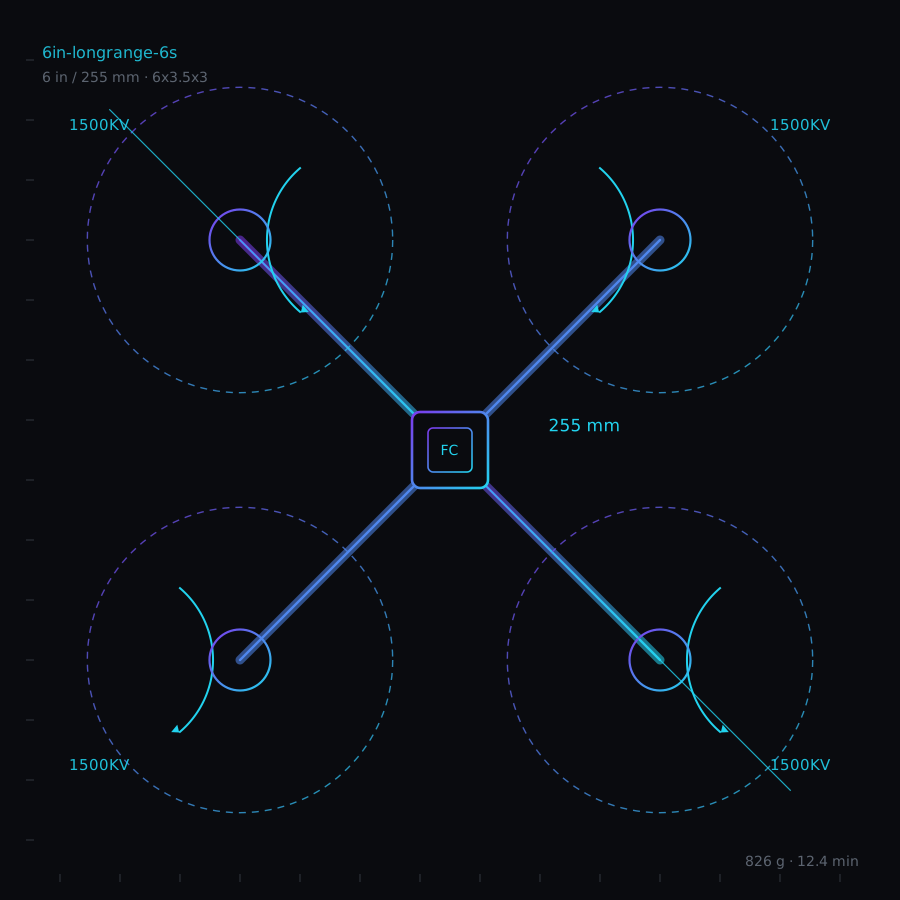
| Wheelbase | 6 in / 255 mm (255 mm) |
|---|---|
| Motors | 1500 KV |
| Props | 6x3.5x3 |
| ESC | AM32 · DShot300 |
| VTX | 800 mW · 5.8 GHz |
| Link | ExpressLRS 915 MHz · 100 Hz |
| AUW | 826 g |
| Flight | 12.4 min |
| Thrust to weight | 5.08 : 1 |
| Rate limit | Actual 500 deg/s · expo 0.70 |
| Filters | PT1 100 Hz / PT1 95 Hz |
| Dynamic notch | Biquad 80-250 Hz |
| RPM filter | On (bidirectional DShot) |
Rates
- Max rate — Actual 500 deg/s · expo 0.70
- Expo — 0.7 · centre sensitivity 190
- Throttle mid — 0.44 · expo 0.16
- Filters — PT1 100 Hz / PT1 95 Hz / Biquad 80-250 Hz
Tuning pass
- Fit the cross brace and re-check the frame resonance with a blackbox spectrum before tuning.
- Set the gyro lowpass to 100 Hz and the dynamic notch to 80-250 Hz.
- Enter roll P 45 / I 100 / D 32 and pitch P 47 / I 104 / D 34, then fly a 60 second cruise test.
- Set 500 deg/s with 0.70 expo and a throttle mid of 0.44 with 0.16 expo.
- Configure GPS rescue with an 8 satellite minimum, a 60 m altitude and a 10 second hover.
- Set the consumed-capacity warning to 1500 mAh and the voltage warning to 3.5 V per cell.
- Test the camera mount by flying a fast descent, then fix the mount before changing any PID value.
Assembly order
- Mount the GPS on a mast 45 mm above the battery and route its cable away from the VTX.
- Balance the 6-inch props on a magnetic balancer; the larger diameter amplifies any imbalance.
- Soft-mount the action camera with at least 3 mm of foam between the mount and the frame.
- Calibrate the current sensor at 10 A and 25 A against a watt meter.
- Set the battery profile to 6S 2200 mAh and the cell count detection to 6S only, never auto.
- Verify the failsafe on the bench with the props fitted and the aircraft restrained.
- Fly a 1 km leg first and record the pack voltage at the turnaround point.
Why 255 mm is the sweet spot
At 255 mm with 2507 motors and 6-inch props the aircraft cruises at 7.8 A, which is 15 percent less than an equivalent 5-inch carrying the same camera. Push the frame to 295 mm and the props get more efficient but the arms get heavier and the pack has to grow, which cancels most of the gain. The measured difference between this 6-inch and a comparable 7-inch on the same 2200 mAh pack is 40 seconds.
Prop and motor matching
2507 at 1500 KV on 6S draws 7.8 A at 55 percent throttle with a 6x3.5x3 prop, and 19 A at full throttle. A lower-pitch 6x3 prop drops cruise current to 6.9 A and adds 50 seconds of flight time, but the aircraft can no longer climb out of a fast descent with a camera on board. Keep the 3.5 pitch if you carry a camera.
Tuning a 6-inch that carries a camera
Roll P 45 with D 32 is deliberately soft because the camera mount is a spring. A stiffer tune makes the camera shake at exactly the frequency the mount resonates at, which on this build is 78 Hz. Raise I to 100 and 104 so the aircraft holds attitude in a descent, and leave D alone; if the footage still shakes, fix the mount rather than the PID.
Rescue and pack management for 3 km legs
Configure rescue with a 10 second hover and a 60 m altitude, and set the consumed-capacity warning to 1500 mAh of the 2200 mAh pack. A 3 km out-and-back at 7.8 A cruise uses about 1350 mAh including the climb to altitude, so the warning gives you roughly 40 seconds of margin to turn around.
Where the extra weight goes
The 826 g breaks down as: 218 g of frame and electronics, 264 g of motors and props, 302 g of battery, 42 g of camera and mount. The camera is only 5 percent of the weight but it is the part that dictates the tune, which is why 6-inch builds are always tuned around the mount first and the motors second.
Build parts
- Frame - 255 mm, 5 mm arms with a 3 mm cross brace
- Motors - 4 x 2507 1500 KV
- ESC - 4-in-1 55 A, AM32 2.17
- Flight controller - H7 30x30 mm with a barometer
- Props - 6x3.5x3, balanced
- VTX - 5.8 GHz 800 mW with a heatsink
- Receiver - ExpressLRS 915 MHz, 100 Hz
- GPS - M10 with a 25 mm patch on a mast
- Battery - 6S 2200 mAh 90C LiPo
- Camera - 19 mm analogue plus a 4K action camera on a soft mount
Common mistakes
- Tuning the PID to remove camera shake; the mount is almost always the cause on a 6-inch.
- Using a 5-inch tune on a 6-inch frame, which leaves the aircraft oscillating in a descent.
- Setting the cell count to auto and having a partially discharged pack detected as 5S.
What matters
- A 6-inch on 2507 1500 KV cruises at 7.8 A, about 15 percent less than a comparable 5-inch with the same camera.
- Keep the 3.5 pitch if you carry a camera; the 3.0 pitch costs climb authority.
- The camera mount, not the PID, is the usual source of shake on a 6-inch build.
- A 3 km out-and-back costs about 1350 mAh of a 2200 mAh pack at 826 g.