Sub-250 g 4-inch long range: 11 minutes under the weight line
The 250 g line is the single most useful constraint in this hobby: below it you fly in a different regulatory category in most countries, above it you need registration and remote identification. This 185 mm build lands at 246 g with a GPS module, a lithium-ion pack and 11.2 minutes of cruise.
Published 2026-09-13 · 185 mm · 246 g · 11.2 min
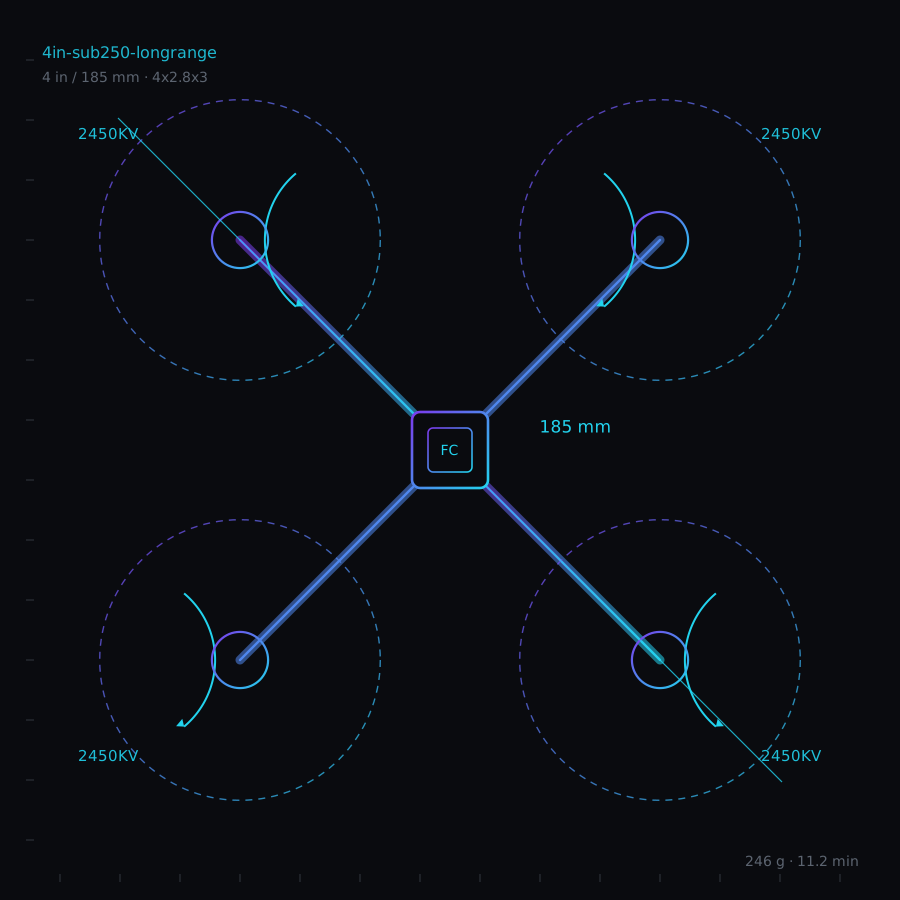
| Wheelbase | 4 in / 185 mm (185 mm) |
|---|---|
| Motors | 2450 KV |
| Props | 4x2.8x3 |
| ESC | Bluejay · DShot300 |
| VTX | 500 mW · 5.8 GHz |
| Link | ExpressLRS 915 MHz · 100 Hz |
| AUW | 246 g |
| Flight | 11.2 min |
| Thrust to weight | 17.07 : 1 |
| Rate limit | Actual 520 deg/s · expo 0.65 |
| Filters | PT1 130 Hz / PT1 120 Hz |
| Dynamic notch | Biquad 100-320 Hz |
| RPM filter | On (bidirectional DShot) |
Rates
- Max rate — Actual 520 deg/s · expo 0.65
- Expo — 0.65 · centre sensitivity 200
- Throttle mid — 0.45 · expo 0.15
- Filters — PT1 130 Hz / PT1 120 Hz / Biquad 100-320 Hz
Tuning pass
- Set Bluejay to 48 kHz and DShot300, then confirm the motors run smoothly at idle for 30 seconds.
- Enter roll P 52 / I 104 / D 30 and pitch P 55 / I 108 / D 32, then fly a 60 second hover-and-drift test.
- Set the gyro lowpass to 130 Hz and the dynamic notch to 100-320 Hz; a 3 mm arm frame rings lower than a 5 mm freestyle frame.
- Set 520 deg/s with 0.65 expo and a throttle mid of 0.45 with 0.15 expo.
- Configure GPS rescue with an 8 satellite minimum, a 60 m altitude and a 9 second hover, then test it at 400 m.
- Set the battery to 4S 850 mAh lithium-ion and the landing warning to 3.35 V per cell.
- Fly a range check in reduced-power mode and confirm full control to 200 m before the first long flight.
Assembly order
- Weigh every component before assembly and keep the running total on a note; a 246 g target is missed by 10 g of wiring if you do not.
- Trim all motor wires to length rather than coiling them; 4 cm of spare wire per motor is 3 g.
- Mount the GPS on a mast so the patch sees sky and the antenna is 40 mm from the VTX.
- Print the GPS mast in a flexible filament so it survives a crash instead of shearing the board.
- Use a single 20x20 stack and no separate VTX bracket; the bracket is 6 g of nothing.
- Set the battery capacity to 850 mAh and verify the current sensor against a watt meter at 5 A.
- Fly 500 m, then 1 km, then 1.5 km on separate days, logging the pack voltage at each distance.
Hitting 249 g with a GPS on board
The GPS and its mast cost 14 g, which on a 246 g aircraft is 5.7 percent of the total. Paying for it means: no camera cage (minus 18 g), a 3 mm arm set instead of 4 mm (minus 22 g), and an 18650 lithium-ion pack instead of a 4S LiPo (minus 34 g against a 1000 mAh LiPo). Nothing on this build is decorative.
1804 motors on 4S: the efficiency window
1804 at 2450 KV on 4S turns a 4x2.8x3 at about 12500 RPM at 50 percent throttle and draws 4.6 A for the whole aircraft. That is the number the flight time comes from: an 850 mAh pack holds about 11.7 Wh usable, and 11.2 minutes at 4.6 A is 0.86 Ah. Push the throttle to 70 percent and current goes to 8.9 A, which cuts the flight to 6.4 minutes.
Tuning a light quad without prop wash
A 246 g quad has very little inertia, so it reacts to every PID change twice as hard as a 700 g build. Start with roll P 52 and pitch P 55, which is low, and raise I instead: 104 and 108 hold altitude in a descent where a heavier quad would simply carry momentum. If the quad shakes in a fast descent, the fix is a 5 point I increase, not a D increase.
GPS rescue on a 1.5 km radius
Rescue is configured with a 9 second hover, a 60 m altitude and an 8 satellite minimum. At 4.6 A cruise the aircraft can climb at 12 A for 20 seconds and still have 30 percent of the pack left, so a 1.5 km radius is the honest limit for a comfortable return with 25 percent reserve. Test the rescue at 400 m before you fly to 1.5 km.
The weight line is a moving target
246 g is with a 3D printed GPS mast, a micro camera and no action camera. Adding a 40 g action camera puts the aircraft at 286 g and into the registration category, so if you want footage, decide before you build: either commit to the heavier category or go with the on-board 4K whoop-style camera at 12 g.
Range check before the first flight
With a 915 MHz link at 100 Hz, a range check on the ground should show full signal to 200 m with the transmitter in range-check mode at reduced power. If it does not, the problem is almost always the antenna: a 915 MHz antenna mounted flat against a carbon arm loses 12 dB, which is the difference between 2 km and 500 m.
Build parts
- Frame - 185 mm ultralight, 3 mm arms, no camera cage
- Motors - 4 x 1804 2450 KV
- ESC - 4-in-1 35 A, Bluejay 0.21
- Flight controller - F7 20x20 mm with a barometer
- Props - 4x2.8x3, balanced
- VTX - 5.8 GHz 500 mW, 20x20 mm
- Receiver - ExpressLRS 915 MHz, 100 Hz
- GPS - M10 with a 15 mm patch, mounted on a 3D printed mast
- Battery - 4S 850 mAh Li-Ion 18650 pack
- Camera - micro analogue, 1/3 in sensor
Common mistakes
- Building to 246 g with a lithium-ion pack and then fitting a 40 g action camera, which moves the aircraft into the registration category.
- Mounting the 915 MHz antenna flat against the carbon frame and losing 12 dB of link budget.
- Raising D to fix shaking on a light quad when the correct fix is more I.
What matters
- 246 g with GPS, a lithium-ion pack and 11.2 minutes of cruise is achievable with a 185 mm frame and 1804 motors.
- Cruise current is 4.6 A; 70 percent throttle more than doubles it and cuts the flight to 6.4 minutes.
- On a light quad, raise I rather than D when the aircraft shakes in a descent.
- A 1.5 km radius with 25 percent reserve is the honest limit of a 4S 850 mAh pack on this build.