5-inch cinematic build: a 812 g flying tripod
A cinematic 5-inch is not a freestyle quad with a camera bolted on. The extra 130 g of camera and mount change the resonance of the whole frame, so the tune is built around the camera plate first and the motors second. This build returns 4.2 minutes of usable one-take footage per pack.
Published By The Rotor Desk 225 mm · 812 g · 4.2 min
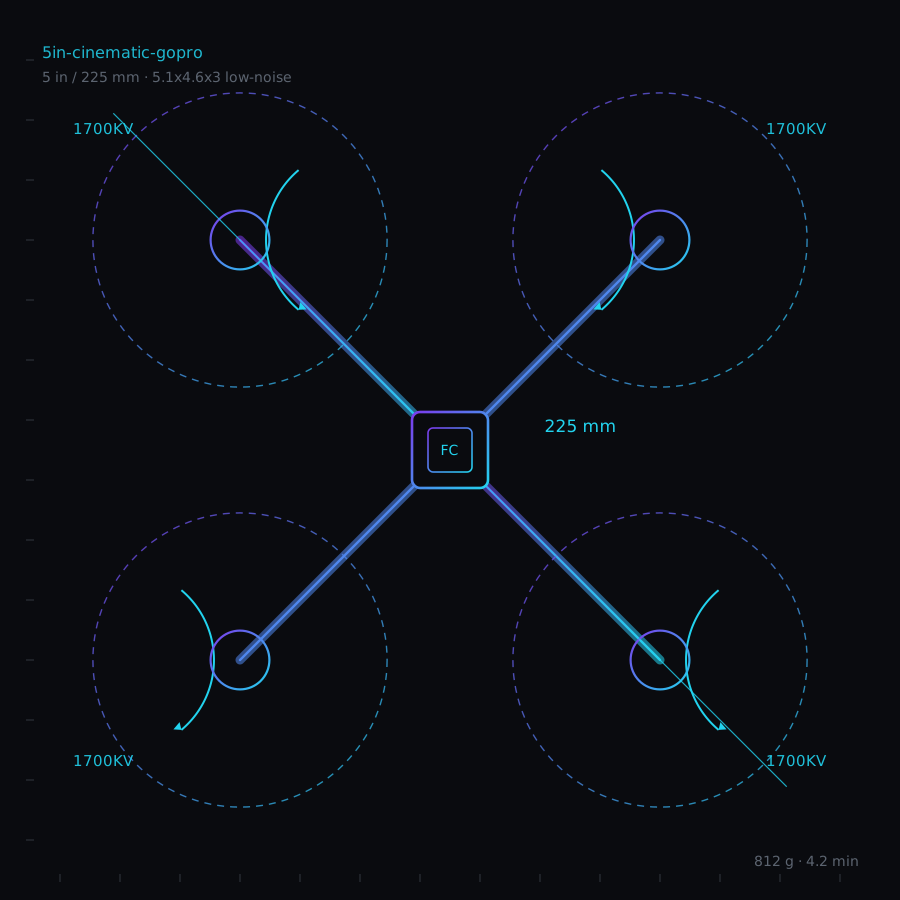
| Wheelbase | 5 in / 225 mm (225 mm) |
|---|---|
| Motors | 1700 KV |
| Props | 5.1x4.6x3 low-noise |
| ESC | AM32 · DShot600 |
| VTX | 800 mW · 5.8 GHz |
| Link | ExpressLRS 2.4 GHz · 150 Hz |
| AUW | 812 g |
| Flight | 4.2 min |
| Thrust to weight | 4.19 : 1 |
| Rate limit | Actual 560 deg/s · expo 0.72 |
| Filters | PT1 110 Hz / PT1 100 Hz |
| Dynamic notch | Biquad 90-280 Hz |
| RPM filter | On (bidirectional DShot) |
Rates
- Max rate — Actual 560 deg/s · expo 0.72
- Expo — 0.72 · centre sensitivity 170
- Throttle mid — 0.5 · expo 0.1
- Filters — PT1 110 Hz / PT1 100 Hz / Biquad 90-280 Hz
Tuning pass
- Fit the camera and mount first, then check the frame resonance with a blackbox spectrum; tune to that number, not to a generic profile.
- Set the gyro lowpass to 110 Hz and the dynamic notch to 90-280 Hz.
- Enter roll P 44 / I 96 / D 36 and pitch P 46 / I 100 / D 38, then fly a slow orbit and watch for overshoot.
- Set the feed-forward to about half of what you would use on a freestyle quad.
- Set 560 deg/s with 0.72 expo, a centre sensitivity of 170 and 0.78 yaw expo.
- Set the throttle mid to 0.5 with 0.1 expo so the hover point is predictable for altitude-critical shots.
- Fly three one-take orbits and review the footage before changing anything.
Assembly order
- Mount the camera plate with at least 3 mm of foam and check that the plate cannot touch the frame under load.
- Balance the props on a magnetic balancer; at 26 A an unbalanced prop is the most common source of shimmer.
- Route the camera power from a filtered 5 V rail and confirm no lines appear in the footage at full throttle.
- Set the battery profile to 6S 1300 mAh and the landing warning to 3.5 V per cell.
- Verify the current sensor at 30 A against a watt meter.
- Set failsafe to Stage 2 with a 0.4 second delay and no rescue.
- Fly a 30 second hover and feel the motors, then fly a full one-take line and review the footage on a large screen.
The camera mount is the airframe
A full-size action camera plus a TPU mount weighs 130 g and sits 40 mm above the frame's centre of gravity, which drops the airframe's first bending mode from 165 Hz to about 105 Hz. Every PID value on this build is chosen to avoid exciting that mode. If you change the mount, re-tune: a mount swap moves the mode by up to 25 Hz and invalidates the D term.
Lower KV and a lower-pitch prop
2207 at 1700 KV on 6S turns a 5.1x4.6x3 at about 21000 RPM at 60 percent throttle, drawing 26 A for the aircraft. A lower-pitch 5.1x4.3 prop drops the current to 22 A and reduces prop noise by about 3 dB, which matters when you are shooting dialogue. The cost is 6 percent less climb rate, which rarely shows up in a cinematic line.
Tuning for smooth, not sharp
Roll P 44 with D 36 and pitch P 46 with D 38 is tuned for smoothness rather than response. The D term here is higher than a freestyle build of the same weight because the camera plate acts as a spring and D is what damps it. Feed-forward is deliberately set low; a high feed-forward term produces the small overshoot at the start of a move that ruins a one-take orbit.
Rates that make a one-take orbit work
560 deg/s with 0.72 expo and a centre sensitivity of 170. The high expo is the important part: it gives you about 60 deg/s for the first 20 percent of stick travel, which is what a slow orbit needs, while still allowing a fast recovery if the shot goes wrong. Yaw expo is set even higher at 0.78.
What 812 g does to the feel
At 812 g the aircraft has enough inertia that it takes about 0.35 seconds to stop a fast sideways move, against 0.2 seconds on a 680 g freestyle build. That is why the rate limit is 560 deg/s rather than 780: the aircraft physically cannot stop faster, and pretending otherwise just adds overshoot to the footage. Plan moves that finish early rather than moves that finish on the stick.
Build parts
- Frame - 225 mm with a 5 mm arm set and a soft-mounted camera plate
- Motors - 4 x 2207 1700 KV
- ESC - 4-in-1 55 A, AM32 2.17
- Flight controller - F7 30x30 mm with a barometer
- Props - 5.1x4.6x3 low-noise
- VTX - 5.8 GHz 800 mW, SmartAudio
- Receiver - ExpressLRS 2.4 GHz, 150 Hz
- Battery - 6S 1300 mAh 120C LiPo
- Camera - full-size action camera on a TPU mount with foam isolation
Common mistakes
- Changing the camera mount and keeping the old PID values; the frame resonance moves and the D term stops damping anything.
- Using a high feed-forward value and adding a small overshoot to the start of every move.
- Setting 780 deg/s on an 812 g aircraft and assuming the extra rate is usable; it just adds overshoot.
What matters
- A full-size camera plus mount drops the frame bending mode from 165 Hz to about 105 Hz.
- A lower-pitch prop cuts 4 A and about 3 dB of noise for 6 percent less climb rate.
- Higher expo and lower rate limits are what make one-take orbits look deliberate.
- At 812 g a fast sideways move takes about 0.35 seconds to stop, so plan moves that finish early.