7-inch heavy lifter: 1.5 kg with a gimbal and a cinema camera
Once you bolt a stabilised gimbal and a real camera onto a 7-inch frame you are flying 1.5 kg, and the tune that worked at 1 kg will oscillate. This build carries 620 g of payload at 1486 g all-up and returns 9.6 minutes of stabilised footage per 6S 5000 mAh pack.
Published By The Rotor Desk 300 mm · 1486 g · 9.6 min
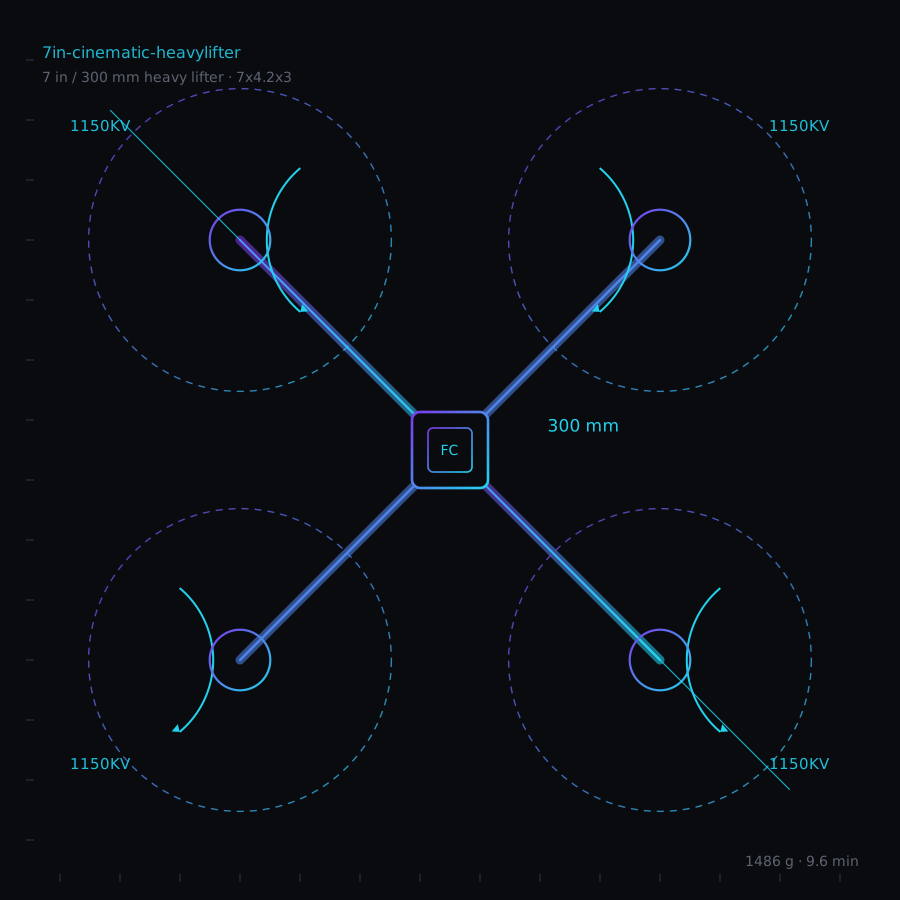
| Wheelbase | 7 in / 300 mm heavy lifter (300 mm) |
|---|---|
| Motors | 1150 KV |
| Props | 7x4.2x3 |
| ESC | AM32 · DShot300 |
| VTX | 1000 mW · 5.8 GHz |
| Link | ExpressLRS 915 MHz · 100 Hz |
| AUW | 1486 g |
| Flight | 9.6 min |
| Thrust to weight | 2.29 : 1 |
| Rate limit | Actual 400 deg/s · expo 0.76 |
| Filters | PT1 85 Hz / PT1 80 Hz |
| Dynamic notch | Biquad 65-200 Hz |
| RPM filter | On (bidirectional DShot) |
Rates
- Max rate — Actual 400 deg/s · expo 0.76
- Expo — 0.76 · centre sensitivity 160
- Throttle mid — 0.44 · expo 0.14
- Filters — PT1 85 Hz / PT1 80 Hz / Biquad 65-200 Hz
Tuning pass
- Set the ESC to DShot300 with AM32 and confirm motor timing is on auto.
- Enter roll P 40 / I 104 / D 38 and pitch P 42 / I 108 / D 40, then fly a 90 second slow tracking pass.
- Set the gyro lowpass to 85 Hz and the dynamic notch to 65-200 Hz; the pendulum effect shows up low in the spectrum.
- Set 400 deg/s with 0.76 expo, a centre sensitivity of 160, a throttle mid of 0.44 and 0.14 expo.
- Fit four silicone isolators under the gimbal and compare the footage before and after.
- Configure GPS rescue with a 10 satellite minimum, an 80 m altitude and a 14 second hover.
- Set the battery to 6S 5000 mAh and the consumed-capacity warning to 3800 mAh.
Assembly order
- Weigh the gimbal and camera together and confirm the payload figure before choosing motors.
- Balance the 7-inch props in pairs; on a heavy lifter the gimbal amplifies any imbalance it can see.
- Mount the gimbal on four 8 mm silicone isolators and check it cannot swing into the arms.
- Route the gimbal power from a separate BEC rather than the flight controller's 5 V rail.
- Calibrate the current sensor at 20 A and 50 A against a watt meter.
- Set the failsafe on the bench with the gimbal fitted and the props removed.
- Fly a 60 second hover and land to feel all four motors and both ESCs for heat.
The payload moves the centre of gravity
A gimbal and camera mounted under the frame drop the centre of gravity about 35 mm below the prop disc, which makes the aircraft pendulous: it swings under the props rather than rotating around them. That is why pitch P is only 42 while pitch D is 40; the D term is damping a pendulum, not a rigid body, and a high P term makes the swing worse rather than better.
80 A of headroom on 7-inch props
2806 at 1150 KV on 6S turns a 7x4.2x3 at about 8200 RPM at 45 percent throttle and draws 34 A for the aircraft, which is 62 percent of the ESC rating. A 7-inch heavy lifter is the one class where the 80 A ESC is genuinely needed: during a gimbal-matched climb the current spikes to 71 A for about a second, and a 60 A ESC will cut out on the third spike.
Tuning a pendulum
Roll P 40 with D 38 and pitch P 42 with D 40 is a low-P, high-D profile, which is the opposite of a freestyle tune. The reason is that the payload swings: a high P term adds energy to the swing instead of stopping it. The throttle curve also matters more than the rates here: mid at 0.44 with 0.14 expo keeps the aircraft at a steady altitude for slow gimbal moves, which is what the operator actually needs.
Gimbal isolation and vibration
The gimbal has its own controller and will fight any vibration above about 25 Hz by adding small corrections you can see as a slow wobble in the footage. Soft-mounting the gimbal with four 8 mm silicone isolators reduces the gyro-visible vibration at the gimbal by about 14 dB. Without the isolators, this build showed a 1.5 degree wobble at 12 Hz; with them, it is below 0.2 degrees.
Flight time and pack choice
A 6S 5000 mAh 45C pack weighs 692 g, which is 47 percent of the 1486 g all-up weight. At 34 A cruise the pack lasts 9.6 minutes to a 3.5 V per cell landing, and the 25 percent reserve point is at 7.1 minutes. Using a 6S 3300 mAh pack saves 190 g and brings the aircraft to 1296 g, but the higher current per cell drops the flight time to 6.2 minutes and the aircraft becomes noticeably less stable in wind.
Build parts
- Frame - 300 mm heavy lifter, 6 mm arms, dual camera plates
- Motors - 4 x 2806 1150 KV
- ESC - 4-in-1 80 A, AM32 2.17
- Flight controller - H7 30x30 mm with a barometer and dual gyro
- Props - 7x4.2x3, balanced in pairs
- VTX - 5.8 GHz 1000 mW with a heatsink
- Receiver - ExpressLRS 915 MHz, 100 Hz
- GPS - M10 with a 25 mm patch on a mast
- Battery - 6S 5000 mAh 45C LiPo
- Camera - full-size cinema camera with a stabilised gimbal
Common mistakes
- Tuning a heavy lifter like a freestyle quad; a high P term adds energy to the payload swing.
- Using a 60 A ESC on 7-inch props and having it cut out on the third current spike of a climb.
- Hard-mounting the gimbal and then trying to remove the resulting 12 Hz wobble in post.
What matters
- A gimbal plus camera drops the centre of gravity about 35 mm, making the aircraft pendulous.
- Low P and high D is correct for a pendulum; a high P term makes the swing worse.
- Current spikes to 71 A during a gimbal-matched climb, so an 80 A ESC is genuinely required.
- Silicone isolators under the gimbal cut the gyro-visible vibration by about 14 dB.