65 mm whoop: 29 grams, 1S and the throttle limit trick
A 65 mm whoop weighs less than a AA battery and has about as much thrust margin as a paper aeroplane. Everything about the tune is a negotiation between 5 A of ESC current and the fact that one motor with a bent bell costs you 25 percent of your total thrust.
Published 2026-09-05 · 65 mm · 29 g · 2.6 min
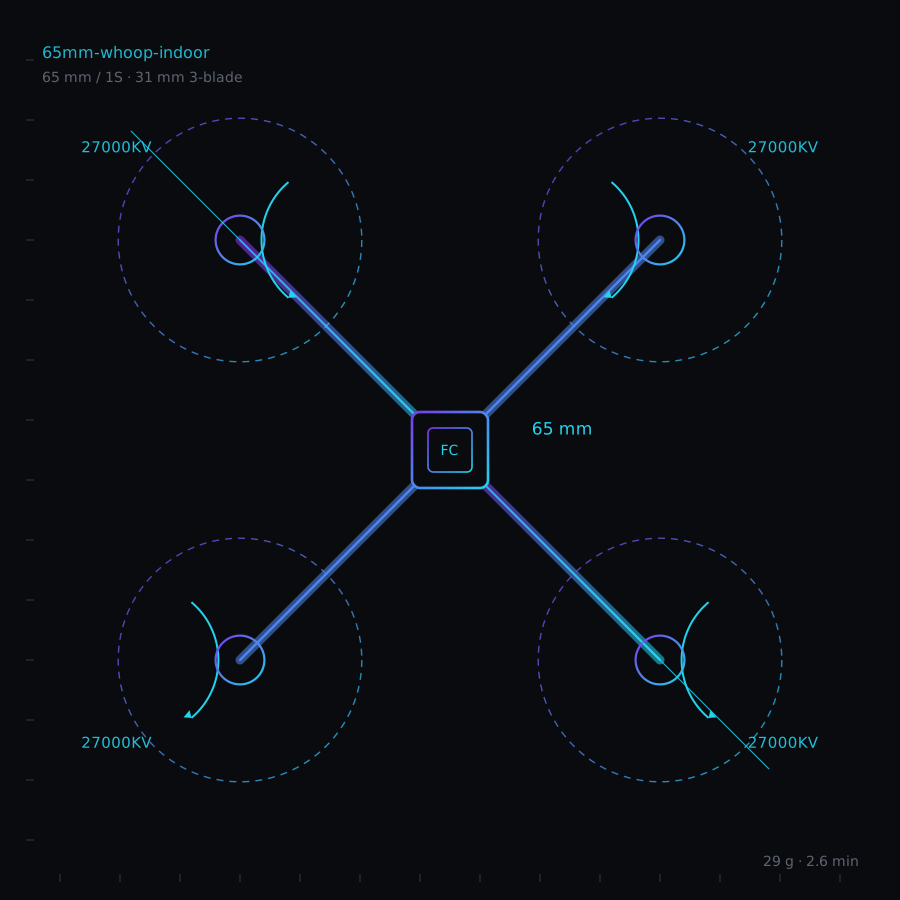
| Wheelbase | 65 mm / 1S (65 mm) |
|---|---|
| Motors | 27000 KV |
| Props | 31 mm 3-blade |
| ESC | Bluejay · DShot300 |
| VTX | 25 mW · 5.8 GHz |
| Link | ExpressLRS 2.4 GHz · 50 Hz |
| AUW | 29 g |
| Flight | 2.6 min |
| Thrust to weight | 5.10 : 1 |
| Rate limit | Actual 600 deg/s · expo 0.4 |
| Filters | PT1 200 Hz / PT1 190 Hz |
| Dynamic notch | Off |
| RPM filter | On (bidirectional DShot) |
Rates
- Max rate — Actual 600 deg/s · expo 0.4
- Expo — 0.4 · centre sensitivity 260
- Throttle mid — 0.5 · expo 0
- Filters — PT1 200 Hz / PT1 190 Hz / Off
Tuning pass
- Flash Bluejay at 48 kHz and set DShot300; higher PWM rates make the 0702 motors whine and lose efficiency.
- Enter roll P 78 / I 140 / D 34 and pitch P 82 / I 145 / D 36, then hover for 20 seconds and listen for oscillation.
- Enable the RPM filter and calibrate the eRPM ratio for 12N14P, then leave the dynamic notch off.
- Set the throttle limit to 82 percent and the throttle mid to 0.5 with no expo.
- Set 600 deg/s with 0.4 expo and 260 centre sensitivity.
- Set failsafe to Stage 2, 0.2 seconds, drop, and verify it on a table with the props spinning at idle.
- Fly four packs, then check for yaw drift by hovering for 10 seconds in a still room.
Assembly order
- Fit the 1 mm carbon brace across the frame before installing the AIO board.
- Trim the motor wires to 8 mm and tin them; the 0702 pads are easy to bridge with excess solder.
- Mount the AIO board with the supplied grommets and check that no solder joint touches the frame.
- Fit the props and spin each motor by hand to confirm the props clear the ducts on all four corners.
- Bind the receiver and set the failsafe before the first flight, not after.
- Charge the pack to 4.35 V for high-voltage mode and set the battery profile accordingly.
- Hover for 30 seconds, land and feel each motor; a warm motor on a 29 g quad means a bent bell or a bad prop.
The 1S power budget
A 1S 300 mAh high-voltage pack delivers about 2.4 Wh, and this build draws 4.1 A in a hard indoor line. That is 2.6 minutes to the 3.2 V landing point. The camera and VTX together take 0.28 A of that, which is 12 percent of the whole budget, so turning the VTX down from 25 mW is pointless below 200 mW but turning the camera off between takes saves real time.
Motor KV and prop count on 65 mm
0702 at 27000 KV turns a 31 mm 3-blade at about 42000 RPM at full throttle. Switching to a 2-blade prop drops the current to 3.4 A and adds 20 seconds of flight time, but the quad loses its ability to climb out of a fast descent in a small room. Indoors, keep three blades; the extra current buys control authority where you need it most.
Rates for tight rooms
600 deg/s with 0.4 expo is deliberately fast for a whoop. The reason is that a 65 mm quad loses altitude in every turn, so you want to complete a 90 degree direction change in about 0.15 seconds and get back on the throttle. Slower rates mean longer turns and more altitude loss. Set 260 centre sensitivity so small corrections around furniture stay gentle.
The throttle limit trick
Cap the throttle at 82 percent in the configurator. A 1S whoop at 100 percent throttle climbs and then sags the pack, and the sag shows up as a 0.4 V drop that makes the PID loop fight a falling voltage. Capping throttle keeps the pack above 3.5 V for the whole flight and makes the tune feel identical on the first and the last lap.
Failsafe indoors
Stage 2 with a 0.2 second delay and a hard drop. A rescue attempt indoors is worse than a fall: the whoop will climb into a ceiling light. Set the same behaviour for the loss-of-signal case in the radio, and check it by switching the transmitter off with the quad on a table and props spinning at idle.
What actually breaks
On a 29 g whoop the order is: props, motor bells, then the frame's motor mounts. The frame mounts go soft after about 30 hard contacts and start letting the motors tilt, which shows up as a slow yaw drift that no PID change removes. Replace the frame when a hand check finds any motor that can rock more than half a degree.
Build parts
- Frame - 65 mm plastic whoop frame with a 1 mm carbon brace
- Motors - 4 x 0702 27000 KV
- ESC - all-in-one 5 A board
- Flight controller - integrated 1S AIO, 25.5 mm mounting
- Props - 31 mm 3-blade, 0.8 mm hub
- VTX - 25 mW integrated, raceband
- Receiver - ExpressLRS 2.4 GHz, 50 Hz
- Battery - 1S 300 mAh HV LiPo
- Camera - integrated 1/4 in analogue, 120 degree lens
Common mistakes
- Running DShot600 on an AIO 5 A board; the board will drop frames and the motors will stutter.
- Replacing a bent motor with a new one and leaving the old props on; the vibration bent the bell in the first place.
- Charging standard 1S packs to 4.35 V without checking whether they are rated for high voltage.
What matters
- A 1S 300 mAh HV pack gives about 2.6 minutes on a 29 g whoop at 4.1 A.
- Keep three blades indoors; two blades cost the vertical authority you need in a small room.
- Cap the throttle at 82 percent so the pack stays above 3.5 V for the whole flight.
- 600 deg/s with 0.4 expo completes a 90 degree turn in about 0.15 seconds.