5-inch ultralight: 268 grams with full-size props
Full-size props on a sub-300 g aircraft give you a strange and useful combination: 6.4 minutes of flight and a glide ratio that lets you cut the throttle and float. This 210 mm build uses 3 mm arms and 2004 motors to hit 268 g without ducts, camera cages or a top plate.
Published By The Rotor Desk 210 mm · 268 g · 6.4 min
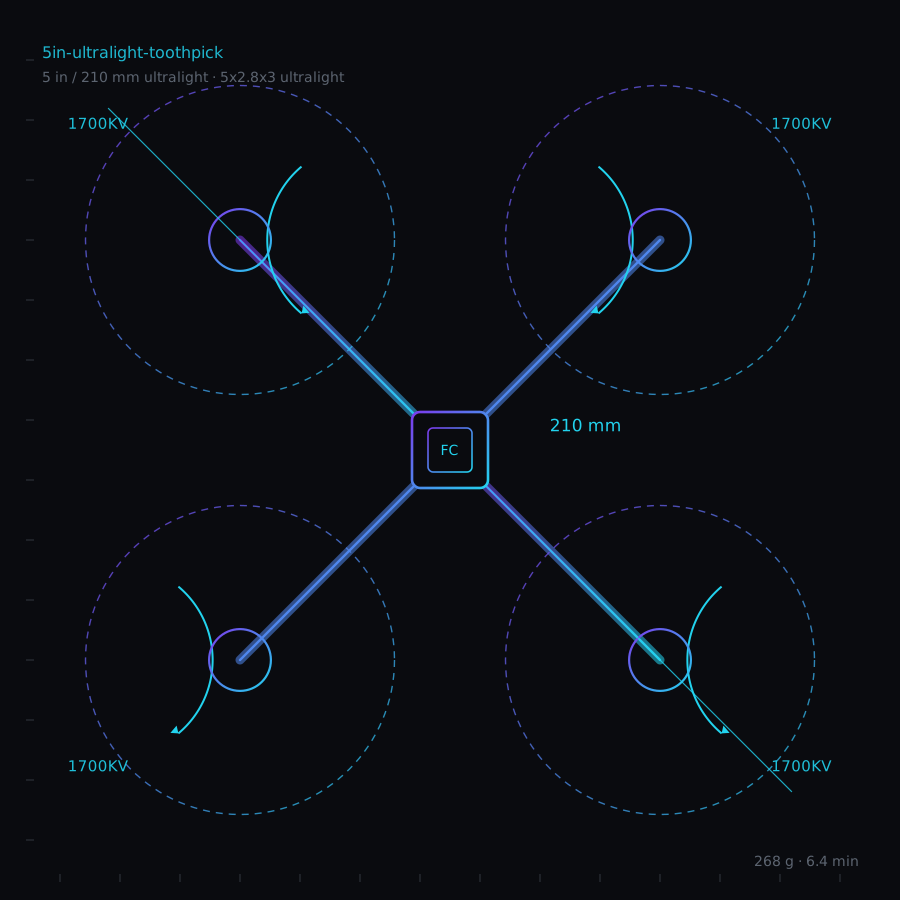
| Wheelbase | 5 in / 210 mm ultralight (210 mm) |
|---|---|
| Motors | 1700 KV |
| Props | 5x2.8x3 ultralight |
| ESC | Bluejay · DShot300 |
| VTX | 500 mW · 5.8 GHz |
| Link | ExpressLRS 2.4 GHz · 250 Hz |
| AUW | 268 g |
| Flight | 6.4 min |
| Thrust to weight | 5.97 : 1 |
| Rate limit | Actual 780 deg/s · expo 0.6 |
| Filters | PT1 140 Hz / PT1 130 Hz |
| Dynamic notch | Biquad 110-350 Hz |
| RPM filter | On (bidirectional DShot) |
Rates
- Max rate — Actual 780 deg/s · expo 0.6
- Expo — 0.6 · centre sensitivity 230
- Throttle mid — 0.45 · expo 0.12
- Filters — PT1 140 Hz / PT1 130 Hz / Biquad 110-350 Hz
Tuning pass
- Set Bluejay to 48 kHz with DShot300 and confirm the 2004 motors start evenly at low throttle.
- Enter roll P 56 / I 110 / D 34 and pitch P 58 / I 116 / D 36, then fly a 60 second cruise.
- Set the gyro lowpass to 140 Hz and the dynamic notch to 110-350 Hz.
- Set 780 deg/s with 0.6 expo, a centre sensitivity of 230 and a throttle mid of 0.45.
- Set failsafe to Stage 2 with a 0.3 second delay and a hard drop.
- Check the arm straightness by eye and with a straight edge after every crash.
- Time a full pack to the 3.5 V per cell landing point and record the number.
Assembly order
- Weigh the arms before and after trimming; a 3 mm arm set is where the weight target is won.
- Solder the motors directly and keep the total wire length under 200 mm.
- Use a 20x20 stack with no separate VTX bracket.
- Skip the top plate over the camera and mount the camera directly to the frame's front standoffs.
- Set the battery profile to 4S 850 mAh and the landing warning to 3.5 V per cell.
- Verify the current sensor at 10 A against a watt meter.
- Fly a 500 m circuit and confirm the arms are still straight and the motors are cool after landing.
Why 2004 motors on a 5-inch prop
A 2004 stator on 4S at 1700 KV turns a 5x2.8x3 at about 13500 RPM at 50 percent throttle and draws 4.9 A for the aircraft. A 2207 in the same position draws 7.8 A for thrust this airframe cannot use without adding weight. The ultralight prop has 2.8 inches of pitch rather than 4.6, which is what keeps the current down; swapping to a standard 5-inch freestyle prop costs 2.3 minutes of flight time.
A 3 mm arm set is the whole design
Switching from 5 mm to 3 mm arms saves 46 g and drops the frame's first bending mode from 165 Hz to about 118 Hz. That is still above the 62 Hz prop passing frequency at cruise, but the margin is thin: a hard prop strike bends a 3 mm arm and the resulting 8 Hz imbalance will look like a bad PID tune. Check the arms for straightness after every crash.
Tuning a 268 g 5-inch
Roll P 56 and pitch P 58 with D at 34 and 36 is higher than a heavy 5-inch would need because the light frame transmits more motor noise into the gyro. The I term at 110 and 116 is what keeps the aircraft from dropping its nose when you cut the throttle, which at 268 g happens noticeably faster than on a 680 g build. Raise I by 5 points before you raise D.
The glide you get for free
At 268 g with 5-inch props the aircraft glides at about 7:1 with the motors idling, which means from 100 m you can travel roughly 700 m without power. It also means that a throttle cut in a dive does not slow you down the way a heavy quad does, so plan descents earlier. The practical use is that you can stretch a cruise from 6.4 to 7.5 minutes by gliding the last two turns of a circuit.
Where the weight actually went
The 268 g breaks down as: 96 g of frame and arms, 62 g of motors and props, 78 g of battery, 32 g of electronics. The battery is only 29 percent of the weight here, against 37 percent on a 700 g build, which is exactly why the flight time is so long: less of the aircraft is being carried by the pack.
Build parts
- Frame - 210 mm ultralight, 3 mm arms, no top plate over the camera
- Motors - 4 x 2004 1700 KV
- ESC - 4-in-1 30 A, Bluejay 0.21
- Flight controller - F4 20x20 mm, 3 g
- Props - 5x2.8x3 ultralight
- VTX - 5.8 GHz 500 mW, 20x20 mm
- Receiver - ExpressLRS 2.4 GHz, 250 Hz
- Battery - 4S 850 mAh 95C LiPo
- Camera - micro analogue, 1/3 in sensor
Common mistakes
- Putting standard 5-inch freestyle props on an ultralight motor and losing 2.3 minutes of flight time.
- Ignoring a bent 3 mm arm and chasing the resulting 8 Hz vibration with PID changes.
- Assuming a light 5-inch will slow down in a dive the way a heavy one does; plan descents earlier.
What matters
- 2004 at 1700 KV on 4S cruises at 4.9 A and returns 6.4 minutes at 268 g.
- A 3 mm arm set saves 46 g and moves the frame bending mode down to about 118 Hz.
- Gliding at 7:1 can stretch a circuit from 6.4 to 7.5 minutes.
- Check the arms for straightness after every hard landing; a bent arm looks like a PID fault.