3-inch cinewhoop: tuning a ducted quad that does not wobble
Ducts are not just a safety cage. They change the airflow over the prop disc, add 40 g of mass at the four corners, and force you to run a lower D term than a comparable open-prop quad. This 155 mm build carries a 4K camera at 318 g and returns 3.8 minutes of usable footage per 4S 850 mAh pack.
Published 2026-09-02 · 155 mm · 318 g · 3.8 min
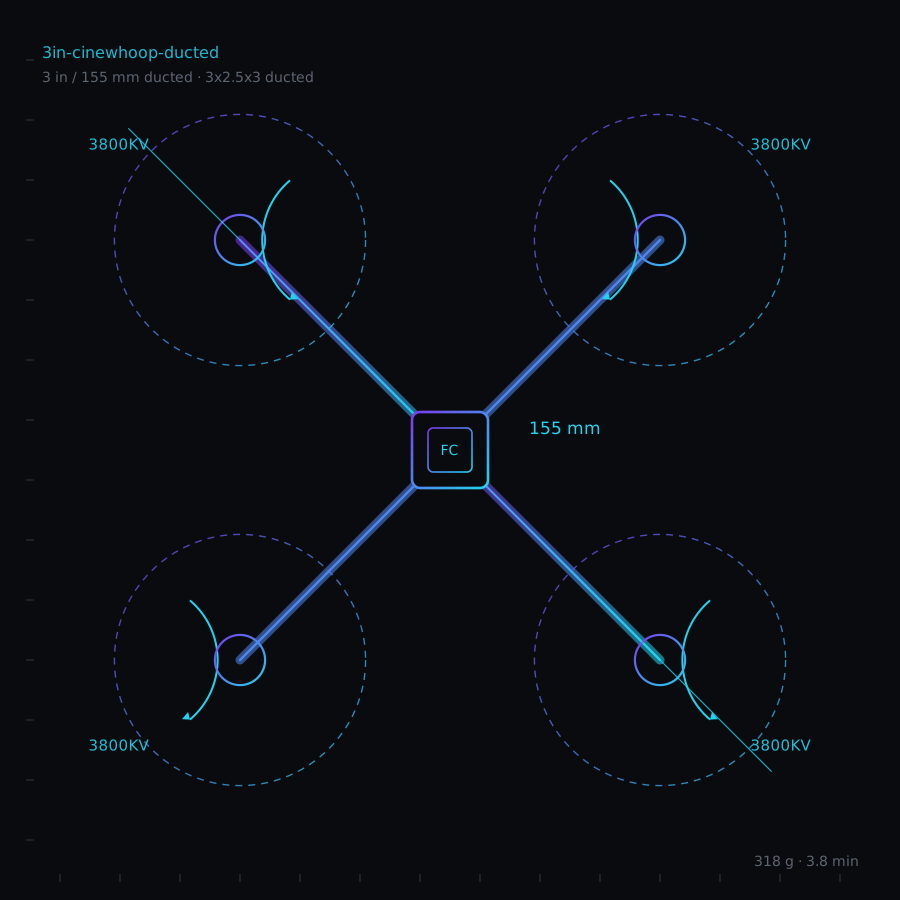
| Wheelbase | 3 in / 155 mm ducted (155 mm) |
|---|---|
| Motors | 3800 KV |
| Props | 3x2.5x3 ducted |
| ESC | Bluejay · DShot300 |
| VTX | 400 mW · 5.8 GHz |
| Link | ExpressLRS 2.4 GHz · 150 Hz |
| AUW | 318 g |
| Flight | 3.8 min |
| Thrust to weight | 10.69 : 1 |
| Rate limit | Actual 420 deg/s · expo 0.66 |
| Filters | PT1 150 Hz / PT1 140 Hz |
| Dynamic notch | Biquad 120-400 Hz |
| RPM filter | On (bidirectional DShot) |
Rates
- Max rate — Actual 420 deg/s · expo 0.66
- Expo — 0.66 · centre sensitivity 195
- Throttle mid — 0.55 · expo 0.12
- Filters — PT1 150 Hz / PT1 140 Hz / Biquad 120-400 Hz
Tuning pass
- Set the ESC PWM to 48 kHz on Bluejay; the lower 24 kHz setting makes the ducts resonate at around 180 Hz.
- Enter roll P 62 / I 118 / D 28 and pitch P 66 / I 124 / D 30, then fly a slow figure-eight indoors.
- Reduce D by 3 points at a time if you see shimmer in the footage; never raise D above 34 on a ducted frame.
- Set the rate profile to 420 deg/s roll and pitch, 300 deg/s yaw, with 0.72 yaw expo.
- Set the throttle mid to 0.55 and expo to 0.12 so cruise sits above the hover point.
- Set failsafe to Stage 2 with a 0.3 second delay; a ducted quad indoors should stop immediately when the link drops.
- Fit a soft mount under the camera and re-check for shimmer before changing anything else.
Assembly order
- Fit the ducts before the motors and check that each duct clears its prop by at least 1 mm on all sides.
- Install the motors with the wires routed inside the duct wall so a prop strike cannot cut them.
- Soft-mount the flight controller on gummies and check that the board cannot touch the frame.
- Mount the camera at 25 degrees and confirm the props are not in frame at that angle.
- Balance the props by adding a small piece of tape to the light blade, then re-check for shimmer.
- Set the ESC brake on stop so the props do not windmill and buzz while descending.
- Fly a 30 second hover and land to feel the motor bells; ducted motors run hotter than open ones.
Ducts change the airflow, not just the safety
A duct recovers some of the tip vortex energy, which adds about 12 percent static thrust at the cost of about 8 percent at forward speed. The practical consequence is that a ducted quad feels punchy in a hover and sluggish at 60 km/h, so build the throttle curve around speed, not around hover. On this build throttle mid sits at 0.55 with 0.12 expo.
3S or 4S on 1404 motors
1404 at 3800 KV on 4S turns a 3x2.5x3 at 24 000 RPM at full throttle and draws 21 A total. The same motor on 3S tops out near 18 000 RPM and 14 A. If your footage is mostly slow indoor movement, 3S gives 5.1 minutes and lower noise; 4S is for flying through gaps and carrying the camera at speed.
Why ducted quads need lower D and higher I
The ducts act as a mechanical damper, so the frame does not ring the way an open 3-inch does. Roll D at 28 is already on the edge; going to 36 produces a visible high-frequency shimmer in the footage that no amount of soft mounting removes. Raise I instead: roll I 118 and pitch I 124 hold attitude through the turbulence the ducts generate when you cross your own wake.
A cine rate preset that keeps yaw flat
Set 420 deg/s on roll and pitch but only 300 deg/s on yaw with 0.72 yaw expo. Yaw is what ruins indoor footage: a 180 degree turn at 420 deg/s overshoots by about 15 degrees and the camera catches the correction. Slower yaw with more expo makes turns settle in one movement.
Noise, weight and the 250 g line
At 318 g this build is over the 250 g registration threshold in most jurisdictions, so it needs registration and remote identification in many countries. Swapping to a 3S 650 mAh pack and removing the camera cage gets to 246 g, but flight time drops to 2.9 minutes and the ducts become the heaviest part of the aircraft relative to thrust.
What the ducts hide
Ducts hide motor damage. A bent bell inside a duct still spins and only shows up as a 3 to 5 degree horizon drift after 90 seconds of flying. Check the bells by hand after every hard contact, because the duct will not tell you.
Build parts
- Frame - 155 mm ducted cinewhoop with replaceable ducts
- Motors - 4 x 1404 3800 KV
- ESC - 4-in-1 45 A, Bluejay 0.21 at 48 kHz PWM
- Flight controller - F7 25.5x25.5 mm with a barometer
- Props - 3x2.5x3 ducted, low pitch
- VTX - 5.8 GHz 400 mW, on-board or 20x20 mm module
- Receiver - ExpressLRS 2.4 GHz, 150 Hz
- Battery - 4S 850 mAh 95C LiPo
- Camera - on-board 4K, 1/1.7 in sensor, 25 degree tilt
Common mistakes
- Copying an open 3-inch PID profile onto a ducted frame and getting shimmer that soft mounting cannot fix.
- Running 24 kHz ESC PWM, which puts the motor noise right in the duct resonance band.
- Flying a 318 g ducted quad indoors without checking whether local rules require registration.
What matters
- Ducts add static thrust and remove forward-speed efficiency; build the throttle curve around speed.
- 1404 at 3800 KV on 3S returns about 5.1 minutes; on 4S about 3.8 minutes with the camera.
- Keep roll D at or below 34 on a ducted frame and raise I instead.
- Slower yaw with more expo is what makes indoor footage look deliberate.