4-inch micro long range: 5 km legs and 16.8 minutes
Four-inch motors on 4S with a 3000 mAh lithium-ion pack is the most efficient long-range package in this set: 412 g, 16.8 minutes of cruise and a 5 km radius with a 25 percent reserve. It is also the quietest, which matters when you are flying over farmland at 6 in the morning.
Published By The Rotor Desk 175 mm · 412 g · 16.8 min
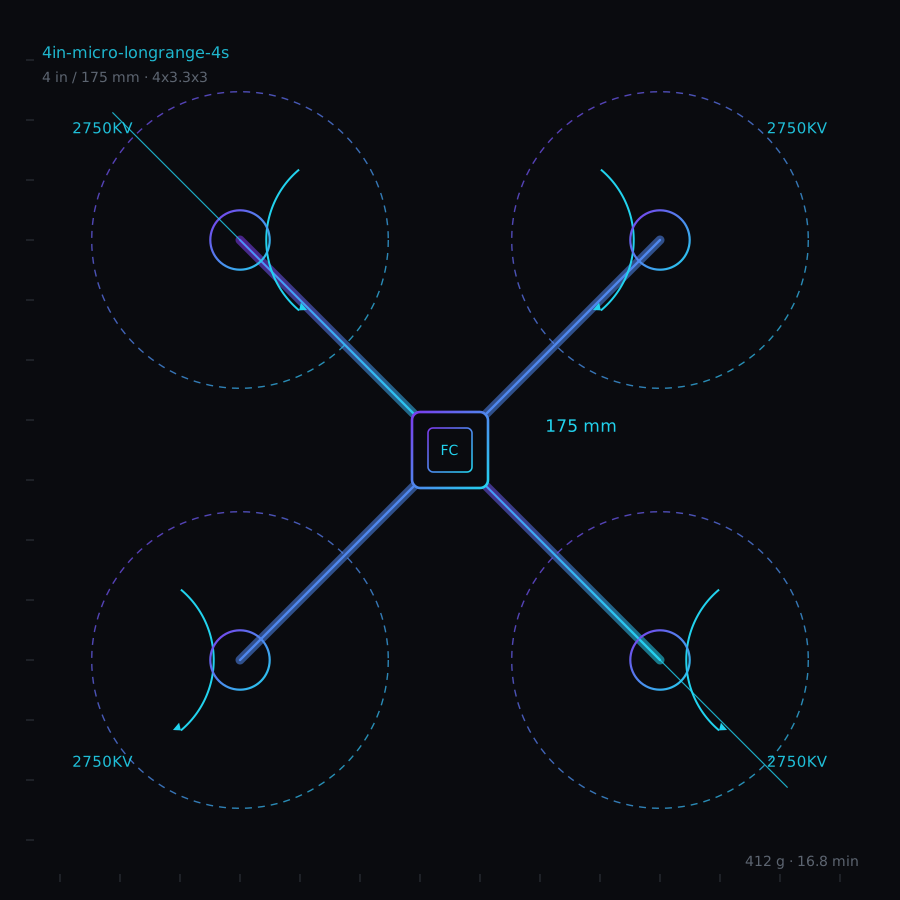
| Wheelbase | 4 in / 175 mm (175 mm) |
|---|---|
| Motors | 2750 KV |
| Props | 4x3.3x3 |
| ESC | Bluejay · DShot300 |
| VTX | 800 mW · 5.8 GHz |
| Link | ExpressLRS 915 MHz · 100 Hz |
| AUW | 412 g |
| Flight | 16.8 min |
| Thrust to weight | 10.19 : 1 |
| Rate limit | Actual 460 deg/s · expo 0.74 |
| Filters | PT1 120 Hz / PT1 115 Hz |
| Dynamic notch | Biquad 95-300 Hz |
| RPM filter | On (bidirectional DShot) |
Rates
- Max rate — Actual 460 deg/s · expo 0.74
- Expo — 0.74 · centre sensitivity 175
- Throttle mid — 0.4 · expo 0.2
- Filters — PT1 120 Hz / PT1 115 Hz / Biquad 95-300 Hz
Tuning pass
- Set Bluejay to 48 kHz with DShot300 and confirm the 1404 motors run cool at idle.
- Enter roll P 50 / I 108 / D 28 and pitch P 52 / I 112 / D 30, then fly a 90 second cruise.
- Set the gyro lowpass to 120 Hz and the dynamic notch to 95-300 Hz.
- Set 460 deg/s with 0.74 expo, a centre sensitivity of 175, a throttle mid of 0.4 and 0.2 expo.
- Configure GPS rescue with a 9 satellite minimum, a 70 m altitude and an 8 second hover.
- Set the battery to 4S 3000 mAh lithium-ion and the landing warning to 3.35 V per cell.
- Test the rescue at 1 km before flying the first 5 km leg.
Assembly order
- Mount the 915 MHz antenna vertically on a flexible mast at least 55 mm above the pack.
- Keep the GPS patch 40 mm away from the video transmitter and its power leads.
- Balance the 4-inch props; at 11000 RPM a small imbalance is the main source of video jitter.
- Set the battery profile to 4S 3000 mAh and the capacity warning to 2400 mAh consumed.
- Calibrate the current sensor at 5 A and 15 A against a watt meter.
- Confirm the rescue switch is on a momentary switch that cannot be knocked accidentally.
- Fly 1 km, then 3 km, then 5 km on separate days, logging the voltage at each turnaround.
Why a small prop and a big pack wins
1404 at 2750 KV on 4S turns a 4x3.3x3 at about 11000 RPM at 40 percent throttle and draws 2.8 A for the aircraft. The pack is 3000 mAh of lithium-ion, which holds about 33 Wh usable. At 2.8 A that is 16.8 minutes; the same aircraft on a 4S 1500 mAh LiPo weighs 96 g less but flies for 8.1 minutes. Micro long range is a battery-led discipline.
The 21700 pack changes the tune
Adding 210 g of battery takes the all-up weight from 202 g to 412 g, which doubles the rotational inertia and changes what the PID has to do. Roll P 50 with D 28 is deliberately low: at this weight the aircraft carries momentum through a turn and a high D term produces a slow oscillation you can hear rather than see. The throttle curve is more important than the PID: mid at 0.4 with 0.2 expo keeps cruise at a comfortable stick position for a long flight.
GPS rescue with a 5 km radius
Rescue is configured with an 8 second hover and a 70 m altitude. At a 2.8 A cruise the aircraft can climb at 9 A for 25 seconds and still hold a 30 percent reserve, so 5 km is the honest radius. The important number is the satellite minimum: set it to 9 rather than 6, because at 5 km a rescue triggered on a poor fix will fly the aircraft in the wrong direction for a long time before you notice.
Rates for a long, boring flight
460 deg/s with 0.74 expo and a centre sensitivity of 175. Long-range flying is 95 percent straight lines, so the rate limit exists mostly to stop you from over-controlling when something surprises you. The high expo means the first 20 percent of stick travel gives about 45 deg/s, which is a gentle correction at 5 km out.
Antenna placement on a 4-inch
At this size there is nowhere to hide an antenna, so placement is the whole link budget. The 915 MHz element is mounted vertically on a flexible mast 55 mm above the pack, and the GPS patch is 40 mm behind it. A 915 MHz antenna laid flat against the battery costs 10 dB, which is the difference between 5 km and 1.6 km.
Build parts
- Frame - 175 mm, 4 mm arms, aluminium-free hardware
- Motors - 4 x 1404 2750 KV
- ESC - 4-in-1 35 A, Bluejay 0.21
- Flight controller - F7 20x20 mm with a barometer
- Props - 4x3.3x3, balanced
- VTX - 5.8 GHz 800 mW, 20x20 mm
- Receiver - ExpressLRS 915 MHz, 100 Hz
- GPS - M10 with a 15 mm patch on a flexible mast
- Battery - 4S 3000 mAh Li-Ion 21700 pack
- Camera - micro analogue, 1/3 in sensor
Common mistakes
- Laying the 915 MHz antenna flat against the battery and losing 10 dB of link budget.
- Setting the satellite minimum to 6 and triggering a rescue on a bad fix 5 km out.
- Raising D to stop the slow oscillation a heavy pack creates, when the correct fix is a lower P and a smoother throttle.
What matters
- 1404 at 2750 KV on 4S cruises at 2.8 A for 16.8 minutes on a 3000 mAh lithium-ion pack.
- The pack is 51 percent of the all-up weight, which is what makes the flight time possible.
- Set the rescue satellite minimum to 9 for long-range work, not 6.
- A 915 MHz antenna mounted vertically on a mast is worth 10 dB against laying it flat.