2-inch HD cinewhoop: indoor footage at 108 grams
The smallest aircraft in this set that still records usable 4K. At 108 g on 2S it flies through doorways at walking pace and returns 3.1 minutes per pack, which is roughly four usable 40 second takes.
Published By The Rotor Desk 105 mm · 108 g · 3.1 min
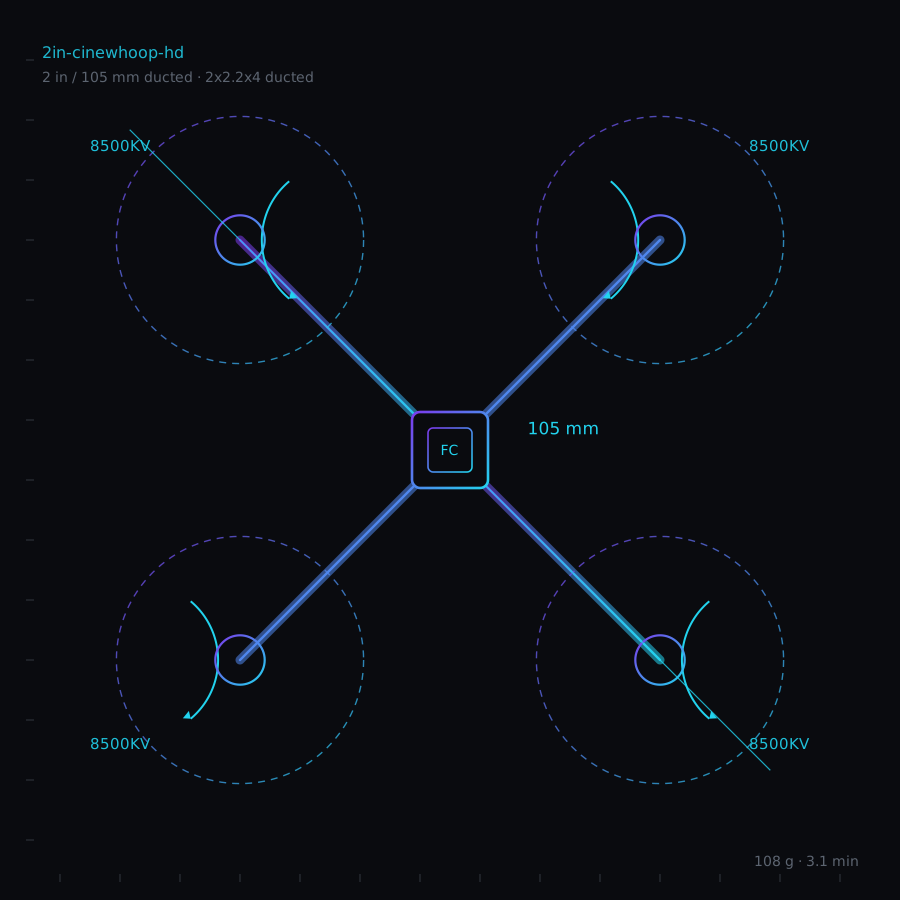
| Wheelbase | 2 in / 105 mm ducted (105 mm) |
|---|---|
| Motors | 8500 KV |
| Props | 2x2.2x4 ducted |
| ESC | Bluejay · DShot300 |
| VTX | 200 mW · 5.8 GHz |
| Link | ExpressLRS 2.4 GHz · 150 Hz |
| AUW | 108 g |
| Flight | 3.1 min |
| Thrust to weight | 31.48 : 1 |
| Rate limit | Actual 500 deg/s · expo 0.68 |
| Filters | PT1 185 Hz / PT1 175 Hz |
| Dynamic notch | Off |
| RPM filter | On (bidirectional DShot) |
Rates
- Max rate — Actual 500 deg/s · expo 0.68
- Expo — 0.68 · centre sensitivity 185
- Throttle mid — 0.54 · expo 0.1
- Filters — PT1 185 Hz / PT1 175 Hz / Off
Tuning pass
- Set Bluejay to 48 kHz with DShot300, then confirm the motors run smoothly at idle for 30 seconds.
- Enter roll P 70 / I 130 / D 28 and pitch P 74 / I 136 / D 30, then fly a slow corridor line.
- Leave the dynamic notch off and enable the RPM filter with the eRPM ratio set for 12N14P.
- Set 500 deg/s roll and pitch with 0.68 expo and 360 deg/s yaw with 0.74 expo.
- Set the throttle mid to 0.54 with 0.1 expo so the cruise point sits above half stick.
- Set failsafe to Stage 2 with a 0.2 second delay and a hard drop.
- Record three takes and check the footage for oscillation before changing any PID value.
Assembly order
- Fit the ducts and check the prop clearance with a paper strip on all four corners.
- Mount the AIO on grommets and confirm the board cannot touch the duct walls.
- Route the motor wires inside the duct wall so a prop strike cannot cut them.
- Set the camera tilt to 20 degrees and confirm the ducts are not in frame.
- Set the battery profile to 2S 450 mAh and the voltage warning to 3.4 V per cell.
- Weigh the aircraft and record the number before the first flight.
- Hover for 30 seconds and land to feel the motors; a warm 1103 indoors means a prop strike.
Thrust-to-weight at 108 g
1103 at 8500 KV on 2S with 2x2.2x4 ducted props produces about 148 g of static thrust in total, which is a 1.37 to 1 ratio. That is low by any freestyle standard, but for indoor flying at a constant 2 m/s it is plenty. The number that matters is recovery: from a 3 m/s descent the aircraft needs about 1.8 m to stop, so keep a metre of clearance above the floor.
Four-blade props indoors
The 2x2.2x4 four-blade prop is chosen for smoothness rather than efficiency: it drops the current from 5.6 A to 4.9 A against a three-blade at the same thrust, and it reduces the blade passing noise by about 2 dB, which matters if the microphone picks up the aircraft. Four blades also make the ducts work harder, which is why the ducts on this frame are 0.6 mm thick rather than 0.4.
Tuning for corridors, not gates
Roll P 70 with D 28 is soft on purpose. A 108 g ducted aircraft in a corridor is flying in its own wake half the time, and a high D term turns that wake into a visible oscillation. Raise I to 130 and 136 instead: it holds a straight line when you pass a doorway where the pressure changes suddenly. The dynamic notch stays off because the RPM filter handles everything the 1103 motors produce.
Rates for a walking-pace shot
500 deg/s with 0.68 expo and a centre sensitivity of 185 gives about 70 deg/s at 20 percent stick, which is what a slow corridor turn needs. The yaw rate is limited to 360 deg/s with 0.74 expo so a 90 degree turn settles in one movement instead of two.
Where the 3.1 minutes go
Camera and VTX together draw 0.42 A on this build, which is 15 percent of the 2.8 A average. That is the price of HD recording on a 108 g aircraft. If you switch the camera to 1080p60 rather than 4K30, current drops by 0.13 A and flight time goes to 3.4 minutes; the trade is resolution on a shot that will mostly be watched on a phone.
Build parts
- Frame - 105 mm ducted, replaceable ducts
- Motors - 4 x 1103 8500 KV
- ESC - all-in-one 12 A board
- Flight controller - 2S AIO with 4K recording on board
- Props - 2x2.2x4 ducted
- VTX - 5.8 GHz 200 mW, integrated
- Receiver - ExpressLRS 2.4 GHz, 150 Hz
- Battery - 2S 450 mAh 75C LiPo
- Camera - on-board 4K, 1/2.3 in sensor, 20 degree tilt
Common mistakes
- Expecting freestyle agility from a 1.37 to 1 thrust ratio and hitting the ceiling instead.
- Running a three-blade prop to gain 0.7 A of current and getting audible blade noise in the recording.
- Turning the VTX power up indoors; 200 mW in a corridor is more than enough and only adds heat.
What matters
- 1103 at 8500 KV on 2S gives about 148 g of thrust for a 108 g aircraft, a 1.37 to 1 ratio.
- Four-blade props cut 0.7 A and about 2 dB against three-blade props at the same thrust.
- Raise I rather than D for flying in your own wake through doorways.
- Camera and VTX take 15 percent of the power budget; dropping to 1080p60 buys 18 seconds.