3.5-inch freestyle: 232 g and still under the registration line
Three and a half inches is the largest prop you can spin at freestyle rates while staying under 250 g with a real battery and a real camera. This 165 mm build lands at 232 g on 4S with 3.6 minutes of aggressive flight.
Published By The Rotor Desk 165 mm · 232 g · 3.6 min
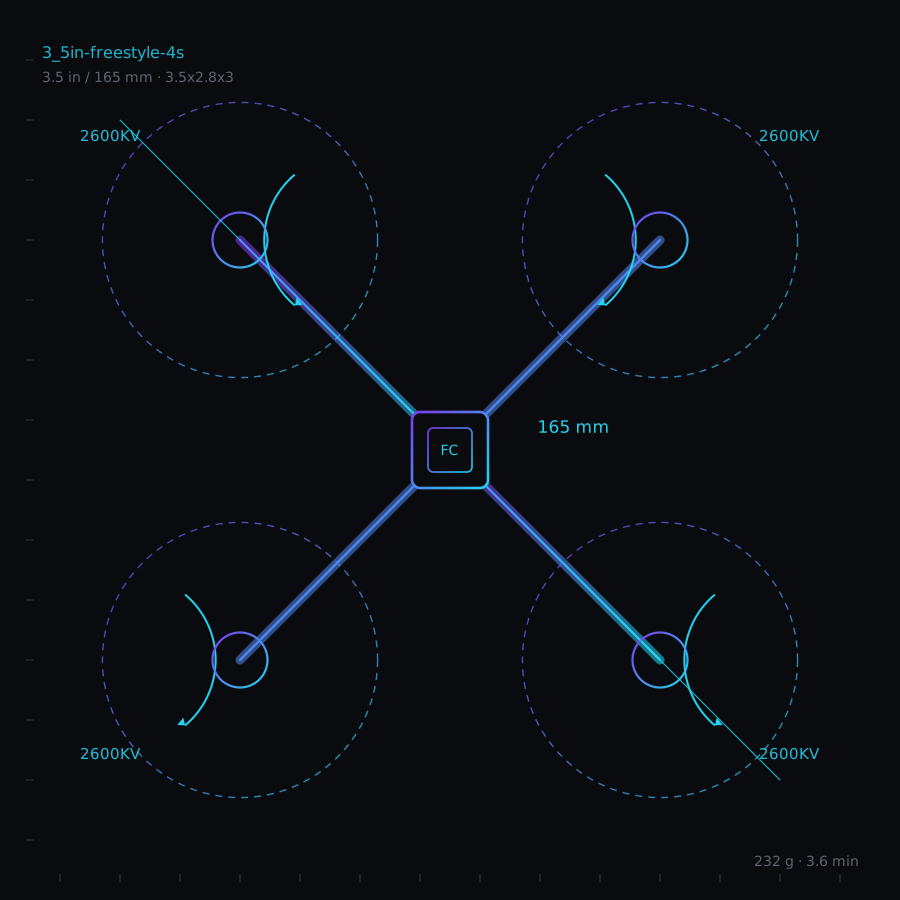
| Wheelbase | 3.5 in / 165 mm (165 mm) |
|---|---|
| Motors | 2600 KV |
| Props | 3.5x2.8x3 |
| ESC | Bluejay · DShot300 |
| VTX | 500 mW · 5.8 GHz |
| Link | ExpressLRS 2.4 GHz · 250 Hz |
| AUW | 232 g |
| Flight | 3.6 min |
| Thrust to weight | 12.50 : 1 |
| Rate limit | Actual 820 deg/s · expo 0.5 |
| Filters | PT1 165 Hz / PT1 155 Hz |
| Dynamic notch | Biquad 130-420 Hz |
| RPM filter | On (bidirectional DShot) |
Rates
- Max rate — Actual 820 deg/s · expo 0.5
- Expo — 0.5 · centre sensitivity 280
- Throttle mid — 0.52 · expo 0.06
- Filters — PT1 165 Hz / PT1 155 Hz / Biquad 130-420 Hz
Tuning pass
- Set Bluejay to 48 kHz with DShot300 and confirm all four motors start together.
- Enter roll P 60 / I 114 / D 32 and pitch P 64 / I 120 / D 34, then fly a throttle chop test.
- Set the gyro lowpass to 165 Hz and the dynamic notch to 130-420 Hz.
- Set 820 deg/s with 0.5 expo, a centre sensitivity of 280 and a throttle mid of 0.52.
- Set failsafe to Stage 2 with a 0.3 second delay and a hard drop.
- Weigh the finished aircraft on a kitchen scale accurate to 1 g and record the number.
- Fly three packs and feel the motors; above 62 degrees C, drop the throttle limit to 85 percent.
Assembly order
- Choose a 20x20 stack rather than a 30x30 to save 12 g and keep the sub-250 g target reachable.
- Solder the motors directly and trim the wires rather than coiling them.
- Fit an XT30 pigtail and keep the wire length under 60 mm.
- Mount the camera on the frame without a separate cage and check the props are out of frame at 25 degrees.
- Set the battery profile to 4S 850 mAh and the voltage warning to 3.5 V per cell.
- Weigh the aircraft with and without the battery and record both numbers.
- Fly a range check and confirm the failsafe before flying anywhere near people.
Why 3.5 inches is the freestyle sweet spot
A 3.5-inch prop on a 165 mm frame gives you about 70 percent of the thrust of a 5-inch at 45 percent of the weight. The result is a power-to-weight ratio that a 5-inch cannot match: 232 g with 4S 850 mAh climbs at about 9.5 m/s against 7.8 m/s for a 680 g 5-inch. It also crashes into things with 40 percent less energy, which matters when you fly around people.
1606 at 2600 KV on 4S
1606 at 2600 KV on 4S turns a 3.5x2.8x3 at about 28000 RPM at full throttle, drawing 24 A for the aircraft. At a freestyle cruise of 55 percent throttle the current is 7.2 A, giving 3.6 minutes. The motors are running close to their limit; after three packs the bells will be at about 58 degrees C, which is acceptable but leaves little margin for a hot day.
Tuning a 3.5-inch for freestyle
Roll P 60 and pitch P 64 with D at 32 and 34. The frame is small and stiff, so resonance sits high at around 240 Hz and the D term has less work to do than on a 5-inch. The value that matters most is I: 114 and 120 keep the aircraft from dropping its nose when you cut the throttle hard, which a sub-250 g aircraft does much more dramatically than a heavier one.
Rates and the throttle curve
820 deg/s with 0.5 expo and a centre sensitivity of 280. This is faster than a 5-inch freestyle profile because the aircraft is lighter and can stop the rotation quickly. The throttle mid is 0.52 with 0.06 expo: at 232 g the hover point is close to half stick, and adding expo would make the low end too soft for punch-outs.
Where the sub-250 g line is won
The list is short and unforgiving: a 20x20 stack instead of 30x30 saves 12 g, direct-soldered motors save 6 g, an XT30 instead of an XT60 saves 5 g, and no camera cage saves 9 g. Everything else on this aircraft is the same hardware a 5-inch uses. If you are 8 g over, the answer is the battery, not the frame.
Build parts
- Frame - 165 mm, 4 mm arms, sub-250 g target
- Motors - 4 x 1606 2600 KV
- ESC - 4-in-1 35 A, Bluejay 0.21
- Flight controller - F7 20x20 mm
- Props - 3.5x2.8x3
- VTX - 5.8 GHz 500 mW, 20x20 mm
- Receiver - ExpressLRS 2.4 GHz, 250 Hz
- Battery - 4S 850 mAh 95C LiPo
- Camera - micro analogue, 1/2.3 in sensor
Common mistakes
- Building to 246 g and then adding a 10 g antenna upgrade, which pushes the aircraft over the line.
- Running a 30x30 stack and a camera cage out of habit, which costs 21 g for no benefit at this size.
- Using a 5-inch freestyle tune on a 3.5-inch and getting oscillation at 240 Hz that the D term cannot fix.
What matters
- 232 g on 4S 850 mAh climbs at about 9.5 m/s against 7.8 m/s for a 680 g 5-inch.
- 1606 at 2600 KV cruises at 7.2 A for 3.6 minutes; the motors run close to their limit.
- I term, not D, is what stops a sub-250 g aircraft dropping its nose on a throttle chop.
- 820 deg/s suits a 232 g aircraft because it can stop the rotation quickly.