5-inch freestyle baseline: 2207 1750 KV on 6S
This is the rig every other 5-inch build gets compared against: a 220 mm frame, 2207 motors at 1750 KV, 6S 1300 mAh and a 682 g all-up weight. The tune below is the one I hand back to people who ask where to start, because it flies predictably on a stock frame and survives a crash that bends an arm.
Published 2026-08-25 · 220 mm · 682 g · 4.5 min
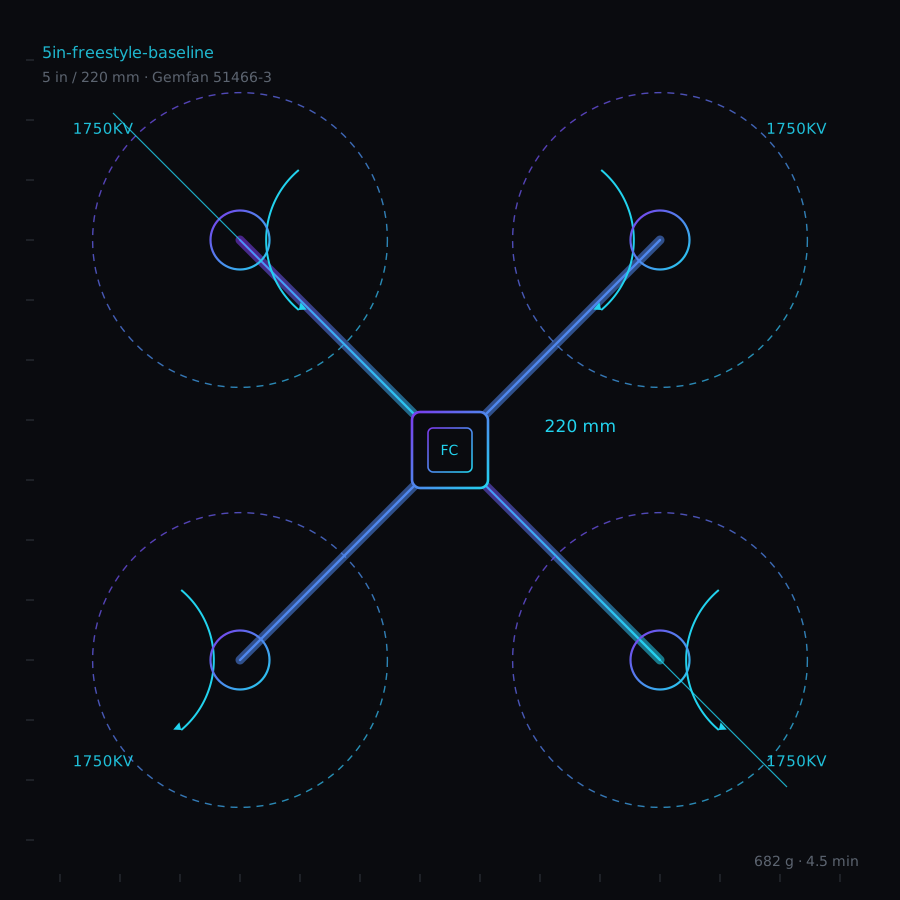
| Wheelbase | 5 in / 220 mm (220 mm) |
|---|---|
| Motors | 1750 KV |
| Props | Gemfan 51466-3 |
| ESC | AM32 · DShot600 |
| VTX | 800 mW · 5.8 GHz |
| Link | ExpressLRS 2.4 GHz · 250 Hz |
| AUW | 682 g |
| Flight | 4.5 min |
| Thrust to weight | 4.25 : 1 |
| Rate limit | Actual 780 deg/s · expo 0.58 |
| Filters | PT1 120 Hz / PT1 110 Hz |
| Dynamic notch | Biquad 90-300 Hz |
| RPM filter | On (bidirectional DShot) |
Rates
- Max rate — Actual 780 deg/s · expo 0.58
- Expo — 0.58 · centre sensitivity 210
- Throttle mid — 0.5 · expo 0
- Filters — PT1 120 Hz / PT1 110 Hz / Biquad 90-300 Hz
Tuning pass
- Flash the ESC to AM32 2.17 and set motor protocol to DShot600 with bidirectional telemetry on.
- Set the gyro update to 8 kHz and the PID loop to 8 kHz, then run the motor test in the configurator with props off.
- Enter the PID values above, then raise pitch D in steps of 3 until a full-throttle punch-out shows no high-frequency shake.
- Set the rate profile to Actual, 780 deg/s, 0.58 expo on roll and pitch, and 0.62 expo on yaw.
- Enable the RPM filter and calibrate the eRPM telemetry ratio for 12N14P motors (ratio 12/2).
- Set failsafe to Stage 2 with a 0.4 second delay and leave GPS rescue disabled.
- Fly three packs of gentle figure-eights, then check motor temperatures: anything above 65 degrees C means the timing or the D term is too high.
Assembly order
- Solder the 4-in-1 ESC to the flight controller and confirm continuity on all four motor pads before applying power.
- Mount the motors with medium-strength threadlocker and check that each bell spins freely by hand.
- Install the VTX with a 30 mm standoff gap from the flight controller so the board does not soak its heat.
- Route the receiver antennas at 90 degrees to each other, away from the video transmitter and the carbon arms.
- Flash the firmware, set the board alignment and the motor direction in the configurator before fitting props.
- Fit the props, then do a first hover at 30 percent throttle for 20 seconds and land to feel each motor bell for heat.
- Tune the PID as described above, then re-check the failsafe by switching the transmitter off on the bench with props removed.
Why 1750 KV on 6S is still the default
On 6S a 1750 KV motor idles at roughly 0.9 A per motor and pulls about 32 A at full throttle on a 51466-3, which lands inside the 55 A ESC with headroom for prop wash spikes. Going to 1900 KV buys about 8 percent more top-end thrust and costs about 90 seconds of flight time on the same pack. For freestyle, where most of the flight sits between 35 and 70 percent throttle, the lower KV keeps the motors in a cooler and more efficient band.
ESC protocol and timing
DShot600 at 8 kHz gyro loop is the sweet spot for this motor size. Going to DShot1200 makes no measurable difference in throttle response on a 2207 and removes one fallback option if a signal wire gets noisy. Motor timing stays at auto (medium-high) on AM32; forcing 22.5 degrees gives a slightly sharper punch but pushes idle current to 1.3 A per motor and raises ESC temperature by about 12 degrees C after a two-minute flight.
The PID profile that survives prop wash
Roll P 48 with D 42 is conservative enough that a fresh build will not oscillate on the default filters. The important number here is pitch D at 45: on a 220 mm frame with 5 mm arms, frame resonance sits near 190 Hz and pitch D is what turns that into visible jello. If you see high-frequency shake in a dive, drop pitch D by 3 points before touching the filters.
Rates: 780 deg/s with centre softness
Actual rates at 780 deg/s on all three axes with 0.58 expo give about 110 deg/s of movement for a 20 percent stick deflection, which is what makes small corrections around trees feel calm. Racers will want 950 deg/s and 0.3 expo; cinematic pilots should copy this rig and drop the max rate to 600 deg/s with expo raised to 0.7.
Failsafe and lost-model behaviour
Stage 2 failsafe with a 0.4 second delay and no GPS rescue. Without a compass and a GPS module, the correct behaviour is a clean motor stop 0.4 seconds after the link drops, not a rescue attempt that flies the quad into something. If you later add GPS, only then enable rescue and set the minimum satellites to 8 before arming.
What breaks first
On this frame the failure order is: props, then the front-left arm, then the camera lens. Carry two spare arms and four sets of props. The 682 g weight is measured with a 1300 mAh pack, a GoPro mount but no camera; adding a full-size action camera puts you at 800 g and you should shorten the flight timer to 3.5 minutes.
Build parts
- Frame - Apex EVO 5 in, 5 mm arms, 220 mm motor-to-motor
- Motors - 4 x 2207 1750 KV, 12N14P
- ESC - 4-in-1 55 A, BLHeli_32 flashed to AM32 2.17
- Flight controller - F7, 30x30 mm, ICM-42688-P gyro
- Props - Gemfan 51466-3 (5.1 x 4.6 x 3)
- VTX - 5.8 GHz 800 mW, SmartAudio 2.1
- Receiver - ExpressLRS 2.4 GHz, 250 Hz packet rate
- Battery - 6S 1300 mAh 120C LiPo
- Camera - 19 mm micro analogue, 1/1.8 in sensor
Common mistakes
- Setting motor timing to 30 degrees to chase punch and cooking the ESCs in summer air.
- Copying a 1900 KV tune onto a 1750 KV motor; the D term will be roughly 15 percent too high.
- Leaving the default 0.2 second failsafe delay on a 5-inch, which is not enough time for the link to recover from a momentary dropout.
What matters
- 2207 at 1750 KV on 6S gives about 4.5 minutes of freestyle on a 1300 mAh pack at 682 g all-up.
- Roll P 48 / D 42 and pitch P 51 / D 45 are safe starting values on the stock filters.
- Keep motor timing on auto; manual timing costs idle current and ESC temperature.
- DShot600 at 8 kHz is enough for this motor class; DShot1200 is not worth the reduced fallback.