5-inch race build: 524 grams and a 950 deg/s rate profile
Race quads are built backwards from the lap time. Every gram you remove comes out of the corner exit, and every degree per second you add comes out of the precision you need to hit a gate. This 215 mm build weighs 524 g with a 6S 1100 mAh pack and turns a 950 deg/s roll without snapping a gate flag.
Published 2026-09-09 · 215 mm · 524 g · 2.8 min
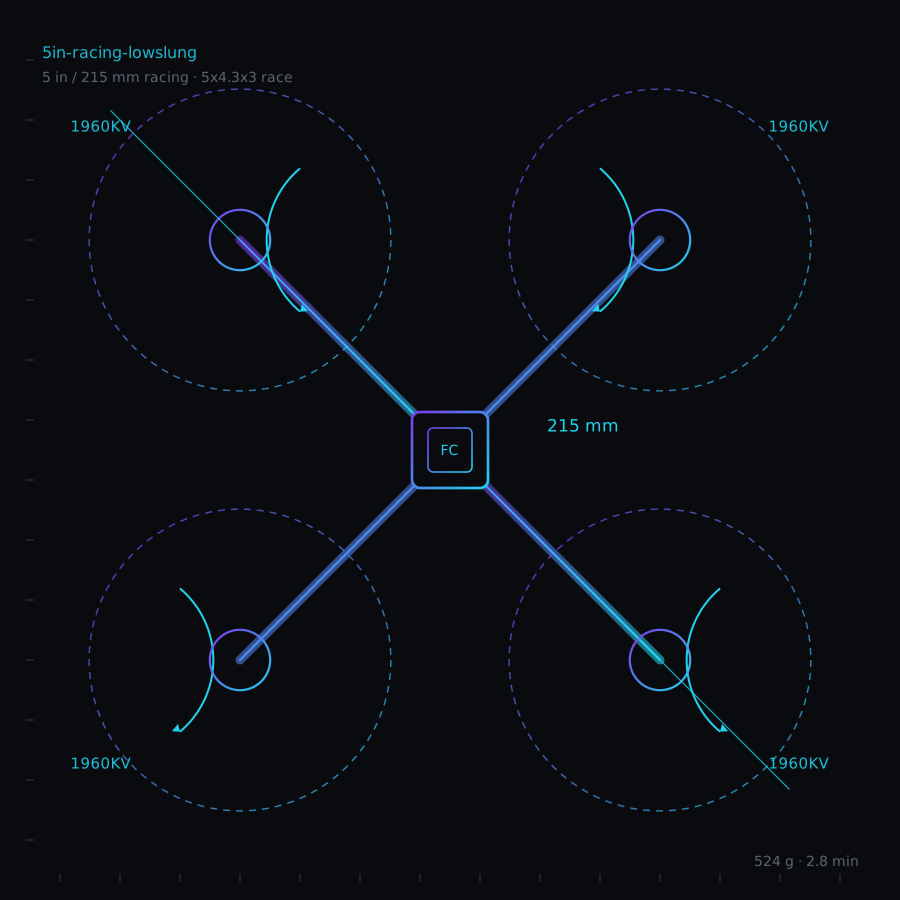
| Wheelbase | 5 in / 215 mm racing (215 mm) |
|---|---|
| Motors | 1960 KV |
| Props | 5x4.3x3 race |
| ESC | AM32 · DShot600 |
| VTX | 25 mW · 5.8 GHz raceband |
| Link | ExpressLRS 2.4 GHz · 500 Hz |
| AUW | 524 g |
| Flight | 2.8 min |
| Thrust to weight | 6.49 : 1 |
| Rate limit | Actual 950 deg/s · expo 0.28 |
| Filters | PT1 160 Hz / PT1 150 Hz |
| Dynamic notch | Biquad 140-500 Hz |
| RPM filter | On (bidirectional DShot) |
Rates
- Max rate — Actual 950 deg/s · expo 0.28
- Expo — 0.28 · centre sensitivity 320
- Throttle mid — 0.58 · expo 0
- Filters — PT1 160 Hz / PT1 150 Hz / Biquad 140-500 Hz
Tuning pass
- Set the ESC to DShot600 with bidirectional telemetry, and leave motor timing on auto.
- Enter roll P 58 / I 90 / D 32 and pitch P 62 / I 94 / D 34 as the starting point.
- Set the gyro lowpass to 160 Hz and the dynamic notch to 140-500 Hz; a race frame rings higher than a freestyle frame.
- Set 950 deg/s, 0.28 expo and 320 centre sensitivity, then raise the max rate in 50 deg/s steps over two practice sessions.
- Configure turtle mode on a switch with the throttle limited to 60 percent and test it on grass.
- Set failsafe to Stage 2 with a 0.25 second delay and a hard drop.
- Balance all four props on a magnetic balancer; at race RPM an unbalanced prop destroys the D term.
Assembly order
- Swap the aluminium standoffs for nylon and weigh the frame before and after to confirm the saving.
- Solder the motors directly to the ESC pads without connectors to save 6 g and two failure points.
- Mount the VTX with a whip antenna straight through the top plate so a crash cannot lever the connector off.
- Fit a 1.8 mm lens camera and set the tilt to 35 degrees for race pace.
- Set the board alignment and check the motor order in the configurator with props off.
- Set the battery profile to 6S and the capacity to 1100 mAh, then verify the current sensor at 20 A.
- Fly three packs of practice laps before making any PID change, and change only one thing at a time.
Saving 40 grams without breaking arms
The easy 40 g on a race build is not the frame or the motors, it is the fasteners and the video system: aluminium standoffs to nylon saves 9 g, a whip antenna instead of a pagoda saves 6 g, and removing the action camera mount saves 14 g. Cutting the arms from 5 mm to 4 mm saves only 11 g and roughly halves the number of crashes the frame survives, which is a bad trade at race speeds.
Motor timing and DShot at 8 kHz
1960 KV on 6S turns a 5x4.3x3 at about 26000 RPM at the start line. Motor timing on auto with DShot600 gives the cleanest throttle response; fixed 22.5 degrees adds about 4 percent top-end thrust and raises current draw by 6 A across the pack, which on a 1100 mAh battery is 12 seconds of flight time gone for a gain you will not feel in a corner.
Race PID: high P, low D around gates
Roll P 58 and pitch P 62 are higher than a freestyle tune because a race lap is a sequence of fast direction changes and P is what makes the quad start turning the instant the stick moves. D stays low at 32 and 34: a race quad hits gates and a high D term turns a clipped gate flag into a full flip. If the quad shudders after a hard corner, drop D by 2 points rather than raising the filter cutoffs.
Rates for gate-to-gate flying
950 deg/s with only 0.28 expo gives a very linear stick, which is what you want when you are aiming at a 1.5 m wide gate from 30 m away. The cost is that small stick movements are twitchy, so set the centre sensitivity to 320 and expect to spend a full practice session recalibrating your thumbs. If you are coming from a freestyle profile, move the max rate up in 50 deg/s steps.
Arming, turtle mode and the race failsafe
Set failsafe to Stage 2 with a 0.25 second delay and a hard drop, and arm turtle mode on a switch. At a race you will land upside down in a corner and 0.25 seconds of link loss should stop the motors instantly, not start a rescue. Turtle mode with the throttle limited to 60 percent will flip you back over without burning an ESC.
Battery choice at this weight
A 6S 1100 mAh 130C pack weighs 198 g and gives 2.8 minutes of race pace. A 1300 mAh pack adds 31 g and 25 seconds, but the extra weight costs about 0.15 seconds per lap on a tight course. On an open course the larger pack wins; on a technical course the smaller one does. Carry both and decide after practice.
Build parts
- Frame - 215 mm race frame, 5 mm arms, aluminium standoffs removed
- Motors - 4 x 2207 1960 KV
- ESC - 4-in-1 50 A, AM32 2.17
- Flight controller - F7, 20x20 mm, no barometer
- Props - 5x4.3x3 race props, hand-balanced
- VTX - 25 mW raceband with a whip antenna
- Receiver - ExpressLRS 2.4 GHz at 500 Hz packet rate
- Battery - 6S 1100 mAh 130C LiPo
- Camera - micro analogue, 1.8 mm lens for a 130 degree field of view
Common mistakes
- Cutting arms down to 4 mm to save weight and then replacing the frame every two race weekends.
- Running 0.7 expo on a race profile, which makes the middle of the stick so soft that gate aiming becomes guesswork.
- Leaving the GPS rescue enabled on a race quad; the rescue altitude on a race build will fly the quad into the timing tower.
What matters
- Fasteners, antenna choice and the camera mount are where the easy 40 g lives, not the arms.
- 950 deg/s with 0.28 expo is linear on purpose; expect a practice session to adapt.
- Keep D low on a race build; a clipped gate plus a high D term equals a flip.
- A 6S 1100 mAh pack returns 2.8 minutes at race pace; a 1300 mAh costs 0.15 seconds a lap on a tight course.